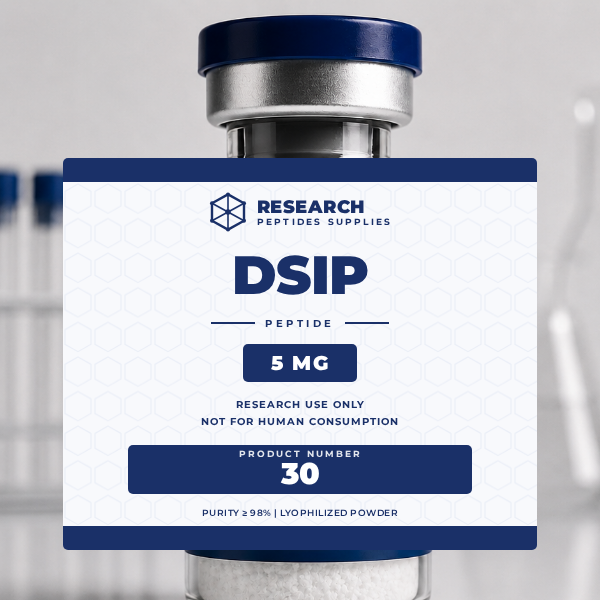
DSIP (Delta Sleep-Inducing Peptide) Research Peptide — Scientific Overview
DSIP (Delta Sleep-Inducing Peptide) is a naturally occurring nonapeptide first isolated by Marcel Monnier and colleagues in 1974 from the cerebral venous blood of rabbits subjected to electrical thalamic stimulation. The peptide was characterized by its ability to induce delta-wave (slow-wave) EEG patterns in rabbits when injected into recipient animals — a defining observation that gave rise to its name. DSIP has since been detected in human and animal blood, pituitary, hypothalamus, and other tissues, and has been studied across a diverse range of biological functions.
Despite its small size (9 amino acids), DSIP interacts with multiple physiological systems including the sleep-wake cycle, stress hormone regulation, circadian pacemaker function, and antioxidant defense. It is of particular research interest because it appears to act as a pleiotropic regulatory peptide that influences multiple systems simultaneously. Research into DSIP has generated a complex and sometimes contradictory literature, making it an interesting subject for further mechanistic investigation.
Research Background
DSIP research has examined its interactions with the hypothalamic-pituitary-adrenal (HPA) axis, particularly stress hormone (cortisol, ACTH) modulation. Studies have also investigated DSIP’s role in antioxidant enzyme regulation, its presence in peripheral tissues including the pineal gland, its circadian rhythm effects, and its potential interaction with opioid systems. Published studies span sleep EEG research, stress biology, oncology (stress-related tumor models), and antioxidant pathway investigation.
Key Research Areas
- Sleep Research: Delta-wave EEG modulation and sleep pattern studies in animal models
- HPA Axis Research: Cortisol, ACTH, and stress hormone pathway investigations
- Circadian Research: Biological clock modulation and circadian rhythm studies
- Antioxidant Research: Effects on antioxidant enzyme activity and oxidative stress markers
- Oncology Research: Stress-related tumor biology investigations in preclinical models
- Neuroendocrine Research: Hypothalamic-pituitary regulatory peptide biology
Technical Specifications
| Parameter |
Value |
| Sequence |
Trp-Ala-Gly-Gly-Asp-Ala-Ser-Gly-Glu |
| Molecular Weight |
848.8 Da |
| Purity |
≥98% (HPLC-verified) |
| Form |
Lyophilized powder, sealed under argon |
| Storage |
−20°C (long-term) |
| Documentation |
Batch-specific COA (HPLC + Mass Spec) |
Storage & Handling (Research Laboratories)
Lyophilized DSIP (Delta Sleep-Inducing Peptide) should be stored at −20°C for long-term preservation, protected from light and moisture. For short-term active research use, 4°C storage is acceptable for up to approximately 4 weeks. Minimize repeated freeze-thaw cycles. Follow standard laboratory peptide reconstitution and handling protocols for all experimental use.
Frequently Asked Questions — DSIP (Delta Sleep-Inducing Peptide) Research
How was DSIP first discovered and characterized?
DSIP was discovered in 1974 by Marcel Monnier and colleagues at the University of Basel. During experiments on electrical stimulation of the thalamus in rabbits, they noticed that blood collected from stimulated rabbits during induced sleep could induce EEG delta waves and behavioral sleep when infused into the ventricles of recipient rabbits. They isolated the active compound from this blood and characterized it as a 9-amino-acid peptide with the sequence Trp-Ala-Gly-Gly-Asp-Ala-Ser-Gly-Glu. This discovery opened a new field of sleep-factor biology research that continues today.
What is known about DSIP’s mechanism of action in sleep research?
DSIP’s exact mechanism in sleep regulation remains incompletely understood — a key reason it continues to attract research interest. Studies have proposed several possible mechanisms: direct action on specific sleep-regulatory brain regions, modulation of HPA axis stress hormones that influence sleep architecture, interaction with opiate receptors, and effects on circadian pacemaker function. DSIP is unusual because it does not act through classical sleep-regulatory channels like adenosine, GABA, or orexin, suggesting it may modulate sleep through less well-characterized regulatory networks.
Does DSIP occur naturally in the human body?
Yes — DSIP has been detected in human blood, cerebrospinal fluid, pituitary tissue, and peripheral organs including the gut and pancreas. Human plasma DSIP levels show circadian fluctuation and are affected by physiological states including stress and sleep deprivation. The natural occurrence of DSIP in humans supports its relevance as a physiological sleep and stress regulatory factor, though the precise physiological roles of endogenous DSIP remain an active area of investigation.
What stress hormone effects has DSIP shown in research?
Multiple research studies have examined DSIP’s interaction with the HPA (hypothalamic-pituitary-adrenal) axis, which controls the stress hormone cascade (CRH → ACTH → cortisol). Results have been mixed — some studies found DSIP reduced cortisol and ACTH responses to stress in animal models, while others showed no consistent effect. This variability may reflect differences in animal models, administration routes, doses, and timing. The investigation of DSIP as a stress-modulating peptide continues in both in vivo animal research and in vitro cell studies.
Is DSIP approved for human use?
No. DSIP is not FDA-approved for human use and is not a pharmaceutical drug or dietary supplement. It is supplied by Research Peptides Supplies strictly for qualified laboratory research use in controlled research environments. It is not for human or veterinary administration.
⚗️ Research Use Only: This product is strictly intended for qualified laboratory and scientific research use by trained professionals in appropriate laboratory settings. It is not intended for human or veterinary administration, therapeutic use, food supplement applications, or any use outside controlled research environments. Not for human consumption.