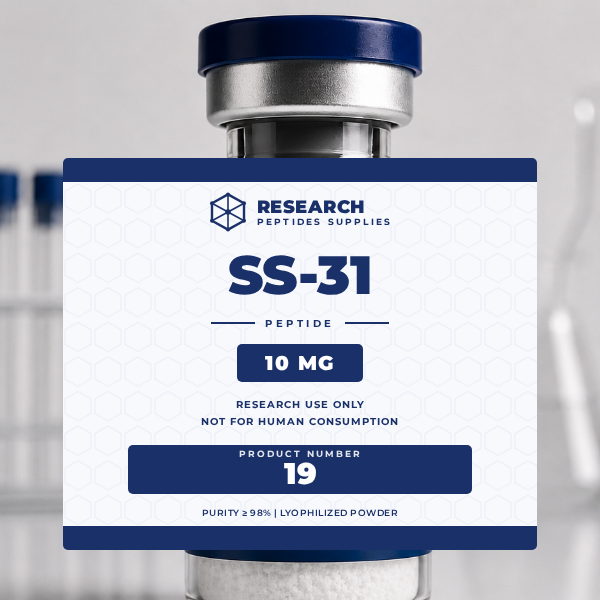
SS-31 / Elamipretide Research Peptide — Scientific Overview
SS-31 (Szeto-Schiller peptide 31), also known as Elamipretide or MTP-131, is a synthetic tetrapeptide developed by Hazel Szeto and Peter Schiller at Weill Cornell Medical College. SS-31 belongs to a class of cell-permeable peptides engineered to selectively concentrate in the inner mitochondrial membrane (IMM) with several-hundred-fold enrichment above cytoplasmic concentrations. This targeting specificity is achieved through the peptide’s alternating aromatic-cationic residues and its interaction with cardiolipin — a unique phospholipid found almost exclusively in the inner mitochondrial membrane.
The interaction between SS-31 and cardiolipin is central to its research profile. Cardiolipin plays a critical structural and functional role in IMM integrity, electron transport chain (ETC) efficiency, and cristae morphology. In aging and in many disease states, cardiolipin undergoes oxidative damage and loss, which impairs ETC function and increases ROS production. SS-31 binds to cardiolipin and prevents its peroxidation, making it a specific tool for studying mitochondrial dysfunction and restoration in research models.
Research Background
SS-31 research spans cardiology (heart failure, ischemia-reperfusion injury), neuroscience (Parkinson’s models, age-related neurodegeneration), kidney biology (acute kidney injury), skeletal muscle biology (aging, atrophy), and rare mitochondrial disease research. Elamipretide has been advanced into clinical trials by Stealth BioTherapeutics, including Phase II/III trials for Barth syndrome and heart failure, making it one of the furthest-advanced mitochondria-targeting research peptides in clinical development.
Key Research Areas
- Mitochondrial Research: Inner mitochondrial membrane biology, ETC function, and cardiolipin-peptide interaction
- Cardiology Research: Heart failure, ischemia-reperfusion injury, and cardiomyocyte protection studies
- Oxidative Stress Research: Mitochondrial ROS reduction and antioxidant pathway investigation
- Kidney Research: Acute kidney injury protection and renal tubular cell biology
- Aging Research: Age-related mitochondrial dysfunction and energy metabolism studies
- Rare Disease Research: Barth syndrome, LHON, and inherited mitochondrial disease models
Technical Specifications
| Parameter |
Value |
| Sequence |
D-Arg-dimethylTyr-Lys-Phe-NH₂ |
| Molecular Weight |
639.8 Da |
| Purity |
≥98% (HPLC-verified) |
| Form |
Lyophilized powder, sealed under argon |
| Storage |
−20°C (long-term) |
| Documentation |
Batch-specific COA (HPLC + Mass Spec) |
Storage & Handling (Research Laboratories)
Lyophilized SS-31 / Elamipretide should be stored at −20°C for long-term preservation, protected from light and moisture. For short-term active research use, 4°C storage is acceptable for up to approximately 4 weeks. Minimize repeated freeze-thaw cycles. Follow standard laboratory peptide reconstitution and handling protocols for all experimental use.
Frequently Asked Questions — SS-31 / Elamipretide Research
How does SS-31 concentrate in mitochondria?
SS-31 accumulates in the inner mitochondrial membrane (IMM) through electrostatic and hydrophobic interactions with cardiolipin, a unique phospholipid that constitutes approximately 20% of the IMM lipid composition. Cardiolipin carries a net negative charge, which attracts the cationic SS-31 peptide. The alternating aromatic (dimethylTyr, Phe) and cationic (D-Arg, Lys) residues in SS-31’s sequence also facilitate membrane partitioning. This results in mitochondrial concentration approximately 5000-fold higher than extracellular concentrations in some cell studies, making SS-31 one of the most mitochondria-targeted small peptides available for research.
What is cardiolipin and why is it important for mitochondrial research?
Cardiolipin (CL) is a unique dimeric phospholipid found almost exclusively in the inner mitochondrial membrane of eukaryotic cells. It is essential for the structural organization and function of electron transport chain (ETC) protein complexes I-V, mitochondrial cristae morphology, mitochondrial fusion/fission dynamics, and apoptotic pathway regulation. In aging and in diseases including heart failure, Barth syndrome, and various neurodegenerative conditions, cardiolipin undergoes peroxidation and remodeling defects that impair ETC efficiency and increase ROS production. SS-31 specifically targets and interacts with cardiolipin, making it a precise molecular tool for cardiolipin biology research.
Has Elamipretide (SS-31) been tested in human clinical trials?
Yes. Stealth BioTherapeutics advanced Elamipretide into multiple clinical trials. A Phase II/III trial (TAZPOWER) examined Elamipretide in Barth syndrome — a rare X-linked mitochondrial disease characterized by cardiolipin remodeling defects. Additional Phase II trials examined Elamipretide in heart failure with preserved ejection fraction (HFpEF) and dry age-related macular degeneration (AMD). While significant safety and mechanistic data were generated, regulatory approval was not achieved. These trials inform the research applications of SS-31 for laboratory researchers.
Is SS-31/Elamipretide approved for human use?
No. SS-31/Elamipretide did not receive FDA approval from clinical trials and is not approved for human therapeutic use. Research Peptides Supplies supplies SS-31 exclusively for qualified laboratory research use in controlled research settings. It is not for human administration.
What documentation comes with SS-31 from Research Peptides Supplies?
SS-31 from Research Peptides Supplies is verified at ≥98% purity by HPLC, with identity confirmed by Mass Spectrometry. A batch-specific COA documenting lot number, HPLC result, mass verification, and testing methodology is provided with every order.
⚗️ Research Use Only: This product is strictly intended for qualified laboratory and scientific research use by trained professionals in appropriate laboratory settings. It is not intended for human or veterinary administration, therapeutic use, food supplement applications, or any use outside controlled research environments. Not for human consumption.