⌕♙🛒
, ,

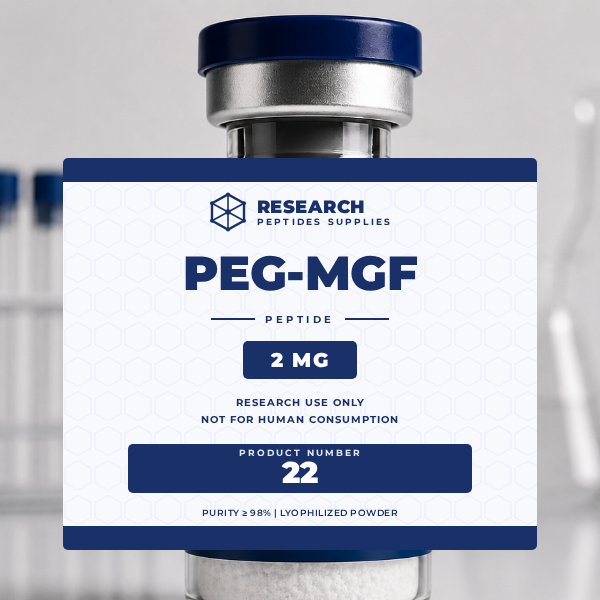
PEG-MGF

$39.99

PEG-MGF (Pegylated Mechano Growth Factor) — the PEGylated form of MGF’s C-terminal E-peptide, incorporating polyethylene glycol modification to dramatically extend plasma stability. Enables in vivo studies of MGF E-peptide biology with longer duration of action than non-PEGylated MGF. Supplied lyophilized at ≥98% purity (HPLC-verified) with batch-specific COA. For research use only.

PEG-MGF (Pegylated Mechano Growth Factor) Research Peptide — Scientific Overview

PEG-MGF refers to a PEGylated (polyethylene glycol-conjugated) form of the Mechano Growth Factor E-peptide — the biologically active C-terminal peptide unique to the MGF splice variant of IGF-1. PEGylation is a well-established pharmaceutical technology that attaches polyethylene glycol (PEG) chains to peptides and proteins to protect them from proteolytic degradation, reduce renal clearance, and dramatically extend circulating half-life. The MGF E-peptide without PEGylation is rapidly degraded in plasma (half-life of minutes), while PEG-MGF has an extended half-life that allows more sustained biological effects in in vivo research models.

PEGylation of the MGF E-peptide preserves the peptide’s receptor-binding characteristics while dramatically improving its pharmacokinetic profile for animal research. This extended half-life makes PEG-MGF more practical for in vivo studies where repeated frequent dosing of the non-PEGylated form would be impractical. Research with PEG-MGF has examined muscle hypertrophy, satellite cell biology, post-damage muscle regeneration, and cardiac protection studies.

Research Background

Published research has compared non-PEGylated MGF E-peptide with PEG-MGF to characterize the pharmacokinetic impact of PEGylation on MGF biology. Studies in rodent models have examined PEG-MGF’s effects on muscle fiber diameter, satellite cell number, and functional outcomes following muscle injury, providing insight into sustained E-peptide biology that cannot be studied with the rapidly-degraded native form.

Key Research Areas

  • Muscle Biology Research: Sustained MGF E-peptide effects on muscle hypertrophy and satellite cell activation
  • PEGylation Research: Pharmacokinetic studies of PEG modification on peptide half-life and bioavailability
  • Post-Injury Research: Muscle regeneration studies with extended E-peptide exposure after damage
  • Cardiac Research: Extended MGF E-peptide effects in cardiac protection models
  • Satellite Cell Research: Prolonged satellite cell activation studies using sustained PEG-MGF exposure
  • In Vivo Pharmacology: PEGylated peptide biology in animal models vs. rapid non-PEGylated forms

Technical Specifications

Parameter Value
Classification PEGylated MGF C-terminal E-peptide
Molecular Weight ~2.9 kDa (peptide) + PEG chain (~2-40 kDa depending on PEG size)
Purity ≥98% (HPLC-verified)
Form Lyophilized powder, sealed under argon
Storage −20°C (long-term)
Documentation Batch-specific COA (HPLC + Mass Spec)

Storage & Handling (Research Laboratories)

Lyophilized PEG-MGF (Pegylated Mechano Growth Factor) should be stored at −20°C for long-term preservation, protected from light and moisture. For short-term active research use, 4°C storage is acceptable for up to approximately 4 weeks. Minimize repeated freeze-thaw cycles. Follow standard laboratory peptide reconstitution and handling protocols for all experimental use.
Frequently Asked Questions — PEG-MGF (Pegylated Mechano Growth Factor) Research

What is PEGylation and how does it improve MGF for research use?
PEGylation is the process of covalently attaching polyethylene glycol (PEG) polymer chains to a molecule — a technique used extensively in pharmaceutical development to improve drug pharmacokinetics. PEG chains attached to peptides reduce enzymatic degradation by sterically blocking proteases, increase molecular size (reducing renal filtration), and often reduce immunogenicity. For MGF, whose unmodified E-peptide has a plasma half-life of only a few minutes, PEGylation dramatically extends bioavailability to allow in vivo research with less frequent administration. Several FDA-approved biologics (PEG-IFN, PEG-filgrastim) use this technology.
How does the research profile of PEG-MGF differ from non-PEGylated MGF?
The primary difference is pharmacokinetic — PEG-MGF provides extended MGF E-peptide exposure in in vivo settings, making it practical for studies where sustained satellite cell activation or prolonged anabolic signaling is needed. Non-PEGylated MGF can be used effectively in cell culture where plasma stability is irrelevant. In animal models, non-PEGylated MGF requires very frequent administration to maintain any meaningful systemic levels. Research comparing the two forms has helped characterize the role of sustained vs. pulsatile MGF E-peptide signaling in muscle biology.
What muscle research findings have been reported with PEG-MGF?
Animal studies examining PEG-MGF in rodent muscle biology have reported increased muscle fiber cross-sectional area, increased satellite cell numbers, and improved functional recovery following induced muscle damage compared to controls. Studies have also examined PEG-MGF effects in aged animals where endogenous MGF production is reduced, with some reports of enhanced muscle regenerative capacity. These findings are from preclinical models and should not be extrapolated to human outcomes without further research.
Is PEG-MGF approved for human use?
No. PEG-MGF is not approved for human use and is not a licensed pharmaceutical. Research Peptides Supplies supplies it for qualified laboratory research use only.
What documentation comes with PEG-MGF?
PEG-MGF from Research Peptides Supplies is verified at ≥98% purity by HPLC, with identity confirmed by Mass Spectrometry. A batch-specific COA is provided with every order.
⚗️ Research Use Only: This product is strictly intended for qualified laboratory and scientific research use by trained professionals in appropriate laboratory settings. It is not intended for human or veterinary administration, therapeutic use, food supplement applications, or any use outside controlled research environments. Not for human consumption.
Shopping Cart
Scroll to Top