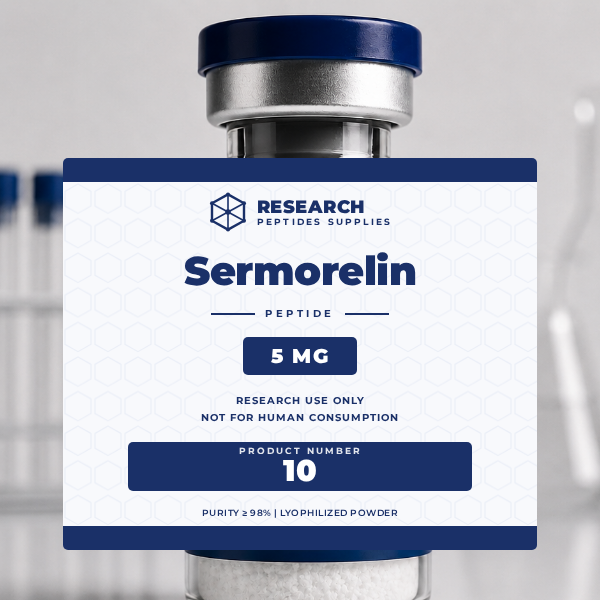
Sermorelin Research Peptide — Scientific Overview
Sermorelin (GHRH 1-29-NH₂; also known as GRF 1-29) is a synthetic peptide corresponding to the first 29 amino acids of human GHRH — the minimal active fragment capable of binding and activating the GHRH receptor with full biological activity. It is the most clinically studied GHRH analog, having been FDA-approved for diagnostic testing of GH deficiency in children (Geref, Serono) and used in clinical research for multiple indications. The peptide’s well-characterized pharmacological profile and clinical history make it a valuable research reference compound.
Unlike modified GHRH analogs such as Mod GRF 1-29 or CJC-1295, native Sermorelin lacks the DPP-IV-resistance modifications and has a shorter biological half-life (approximately 11-12 minutes in humans). This makes Sermorelin useful as a reference GHRH compound for comparing the pharmacological profiles of modified analogs, for studying natural-mimetic GHRH receptor pharmacology, and for GH secretion research where a well-defined, clinically-validated reference compound is required.
Research Background
Published Sermorelin research is extensive, spanning pediatric GH deficiency treatment, adult GH deficiency investigation, pituitary function testing, and age-related GH decline research. Multiple published randomized clinical trials have examined Sermorelin in GH-deficient adults and elderly subjects, documenting its capacity to stimulate pulsatile GH secretion and increase IGF-1 levels with a favorable safety profile compared to recombinant human GH replacement.
Key Research Areas
- GHRH Research: Receptor pharmacology, binding kinetics, and minimal active sequence studies
- Pituitary Function Research: Diagnostic GH secretion testing and somatotroph function investigation
- GH Deficiency Research: GH secretion stimulation in GH-deficient animal and human models
- GH Axis Research: GHRH-somatostatin interplay and GH pulse regulation studies
- Aging Research: Age-related GH decline and GHRH-axis responsiveness in older subjects
- Comparative Pharmacology: Reference GHRH compound for comparing modified analog activity profiles
Technical Specifications
| Parameter |
Value |
| Sequence |
GHRH(1-29)-NH₂ |
| Molecular Weight |
3357.9 Da |
| Purity |
≥98% (HPLC-verified) |
| Form |
Lyophilized powder, sealed under argon |
| Storage |
−20°C (long-term); 4°C (short-term) |
| Documentation |
Batch-specific COA (HPLC + Mass Spec) |
Storage & Handling (Research Laboratories)
Lyophilized Sermorelin should be stored at −20°C for long-term preservation, protected from light and moisture. For short-term active research use, 4°C storage is acceptable for up to approximately 4 weeks. Minimize repeated freeze-thaw cycles. Follow standard laboratory peptide reconstitution and handling protocols for all experimental use.
Frequently Asked Questions — Sermorelin Research
What is the clinical history of Sermorelin?
Sermorelin was FDA-approved under the brand name Geref (Serono) for the diagnostic assessment of pituitary GH secretion capacity in pediatric GH deficiency. It was used as the GHRH stimulation test — a diagnostic test where Sermorelin administration triggers a measurable GH pulse from the pituitary that is measured to assess somatotroph function. Geref was also approved for long-term treatment of GH deficiency in children. FDA approval was voluntarily withdrawn by Serono in 2008 for commercial reasons, not safety concerns. Sermorelin remains a well-studied reference compound in GH biology research.
How does Sermorelin compare to Mod GRF 1-29 in research?
Sermorelin is native GHRH(1-29) without modification, while Mod GRF 1-29 (CJC-1295 No DAC) incorporates four amino acid substitutions for DPP-IV resistance and enhanced stability. Sermorelin has a shorter half-life (~11-12 minutes in humans) compared to Mod GRF 1-29 (~30 minutes). In research, Sermorelin serves as the clinical reference standard and is used when studying natural GHRH pharmacology. Modified analogs are preferred when longer duration of action is needed for the experimental protocol. Both stimulate the same GHRH receptor but with different pharmacokinetic profiles.
What GH-axis research has been conducted with Sermorelin in adults and elderly subjects?
Multiple randomized controlled trials have examined Sermorelin in GH-deficient adults and elderly subjects. Studies by Walker et al. and Khorram et al. examined chronic Sermorelin administration in healthy elderly men and women, documenting dose-dependent increases in plasma GH pulse amplitude, IGF-1 levels, and sleep quality parameters. These trials found that Sermorelin could partially restore age-reduced GH secretion with a more physiological profile than recombinant GH administration, generating research interest in GHRH analogs as tools for studying GH aging biology.
Is Sermorelin currently approved for human use?
Sermorelin was previously FDA-approved (Geref) but was voluntarily withdrawn from the market in 2008. Some compounding pharmacies continue to make it under prescription in the US. For research purposes, Sermorelin is supplied by Research Peptides Supplies strictly for qualified laboratory research use only and is not intended for human administration outside appropriate research contexts.
What documentation is provided with Sermorelin?
Sermorelin from Research Peptides Supplies is verified at ≥98% purity by HPLC with identity confirmed by Mass Spectrometry. A batch-specific COA with lot number, testing data, and methodology is provided with every order.
⚗️ Research Use Only: This product is strictly intended for qualified laboratory and scientific research use by trained professionals in appropriate laboratory settings. It is not intended for human or veterinary administration, therapeutic use, food supplement applications, or any use outside controlled research environments. Not for human consumption.