CJC-1295 Research Peptide — Scientific Overview
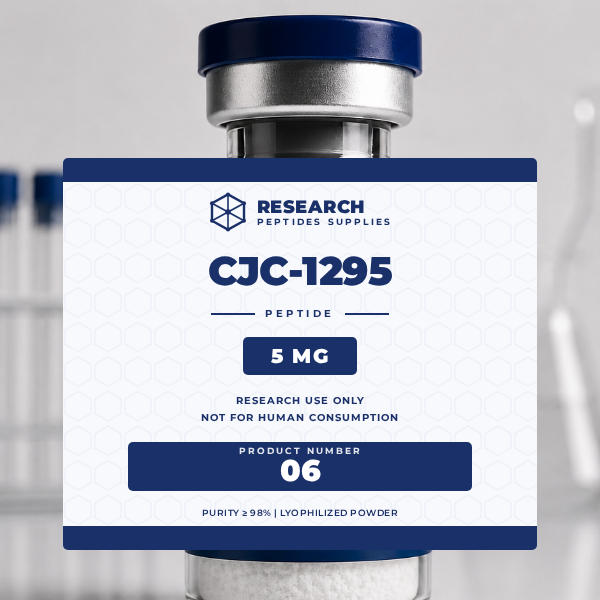
CJC-1295 (also referred to as CJC-1295 with DAC) is a synthetic growth hormone-releasing hormone (GHRH) analog engineered for extended bioavailability through the Drug Affinity Complex (DAC) technology. CJC-1295 was developed by ConjuChem Biotechnologies and shares structural similarity with GHRH(1-29), the naturally occurring first 29 amino acids of human GHRH, but incorporates amino acid substitutions at positions 2, 8, 15, and 27 to enhance stability and reduce enzymatic degradation.
The DAC component consists of a reactive maleimide group capable of covalently binding to serum albumin’s free cysteine residue (Cys-34). This albumin binding confers a dramatically extended half-life compared to native GHRH and non-DAC GHRH analogs. CJC-1295 is studied primarily in the context of growth hormone axis research, pituitary biology, and GH secretion pathway investigations in preclinical models.
Research Background
GHRH is a 44-amino-acid hypothalamic hormone that stimulates synthesis and pulsatile release of growth hormone (GH) from somatotrophs in the anterior pituitary. Native GHRH has a half-life of only 6-7 minutes due to rapid degradation by dipeptidyl peptidase-IV (DPP-IV). CJC-1295 was engineered to overcome this limitation by combining structural modifications that confer DPP-IV resistance with albumin-binding technology that further extends plasma half-life to approximately 6-8 days in animal models. This makes CJC-1295 a valuable research tool for studying prolonged GH axis stimulation in preclinical settings.
Key Research Areas
- Growth Hormone Axis Research: GHRH receptor binding, signaling, and GH secretion pathway studies
- Pituitary Biology: Somatotroph cell function and GH release mechanisms
- IGF-1 Pathway Research: GH-mediated IGF-1 production and signaling studies in animal models
- Pharmacokinetic Research: Albumin-binding technology and extended half-life peptide design
- Metabolic Research: GH-axis effects on metabolic parameters in preclinical models
- Body Composition Research: GH secretagogue effects on body composition parameters in animal studies
Technical Specifications
| Parameter |
Value |
| Classification |
GHRH Analog with DAC (Drug Affinity Complex) |
| Molecular Weight |
~3647 Da (peptide backbone) |
| Purity |
≥98% (HPLC-verified) |
| Form |
Lyophilized powder, sealed under argon |
| Storage |
−20°C (long-term); 4°C (short-term) |
| Documentation |
Batch-specific COA (HPLC + Mass Spec) |
Frequently Asked Questions — CJC-1295 Research
What is the difference between CJC-1295 with DAC and CJC-1295 without DAC?
CJC-1295 with DAC includes a maleimide-lysine linker (the Drug Affinity Complex) that covalently bonds the peptide to albumin’s free cysteine residue, extending plasma half-life to approximately 6-8 days in animal models. CJC-1295 without DAC (also sold as Mod GRF 1-29) lacks this albumin-binding technology and has a shorter half-life of approximately 30 minutes. Researchers choose between the two based on the experimental protocol — long-term sustained GH axis stimulation studies typically use the DAC form, while studies mimicking more pulsatile release patterns may prefer the non-DAC form.
Why is GHRH analog research significant for GH biology?
Growth Hormone (GH) is a critically important anabolic hormone regulating body composition, metabolic function, tissue growth, and immune activity. GH secretion is primarily controlled by the interplay between GHRH (stimulatory) and somatostatin (inhibitory) from the hypothalamus acting on pituitary somatotrophs. Synthetic GHRH analogs like CJC-1295 allow researchers to study GH axis regulation, receptor signaling, and downstream IGF-1 pathway effects in controlled experimental models without the rapid enzymatic degradation that limits native GHRH studies.
Has CJC-1295 been studied in human clinical trials?
Yes — CJC-1295 was advanced into Phase I and Phase II clinical research by ConjuChem Biotechnologies, with published studies examining its pharmacokinetics, GH response, and IGF-1 modulation in human subjects with GH deficiency. These studies documented dose-dependent GH stimulation and confirmed the extended half-life through the albumin-binding DAC mechanism. However, it did not receive regulatory approval for clinical use. Research Peptides Supplies supplies CJC-1295 strictly for laboratory research use, not for human administration.
Why is CJC-1295 often studied alongside Ipamorelin?
CJC-1295 and Ipamorelin target different but complementary pathways in GH regulation. CJC-1295 acts on GHRH receptors to stimulate GH secretion, while Ipamorelin acts on ghrelin receptors (GHS-R1a) as a selective GHRP (growth hormone releasing peptide). When studied together in preclinical models, GHRH and ghrelin receptor agonism can produce synergistic effects on GH secretion. Research combining these two peptide classes examines how simultaneous activation of both receptor pathways affects GH pulse amplitude and overall GH axis dynamics.
Is CJC-1295 approved for human use?
No. CJC-1295 is not approved by the FDA or any regulatory body for human therapeutic use. Research Peptides Supplies supplies CJC-1295 exclusively for qualified laboratory and scientific research use by trained professionals in appropriate research settings. It is not a pharmaceutical drug, supplement, or food ingredient and must not be used for human or veterinary administration.
⚗️ Research Use Only: This product is strictly intended for qualified laboratory and scientific research use by trained professionals in appropriate laboratory settings. It is not intended for human or veterinary administration, therapeutic use, food supplement applications, or any use outside controlled research environments. Not for human consumption.