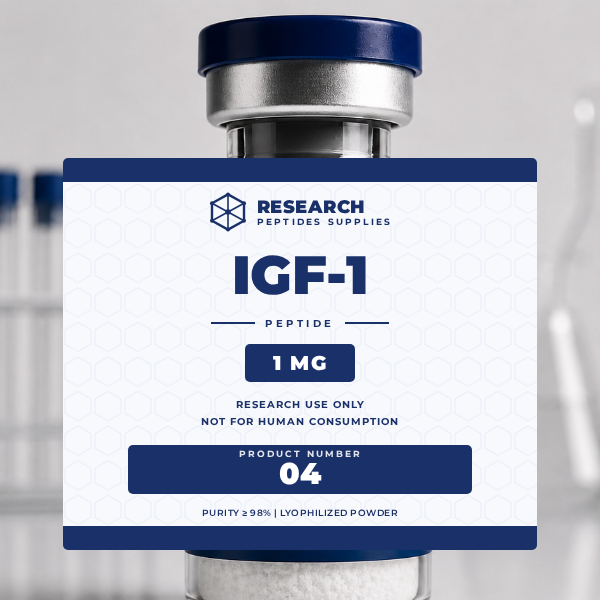
IGF-1 Research Peptide — Scientific Overview
Insulin-like Growth Factor 1 (IGF-1, formerly called Somatomedin C) is a 70-amino-acid single-chain polypeptide that structurally resembles proinsulin and serves as the primary anabolic mediator of growth hormone (GH) action in peripheral tissues. IGF-1 is synthesized predominantly in the liver in response to GH stimulation but is also produced locally in many other tissues where it acts in both endocrine and paracrine/autocrine fashions. As one of the most important growth-promoting hormones in the body, IGF-1 influences virtually every organ system during development and throughout adult life.
IGF-1 signals through the IGF-1 receptor (IGF-1R) — a receptor tyrosine kinase with structural and functional similarity to the insulin receptor. IGF-1R activation triggers multiple intracellular signaling cascades including the PI3K/Akt/mTOR pathway (promoting protein synthesis, cell survival, and glucose uptake) and the MAPK/ERK pathway (promoting cell proliferation and differentiation). The central importance of these pathways in both normal physiology and pathological conditions (cancer, metabolic disease, muscle wasting) makes IGF-1 one of the most intensively studied peptides in biomedical research.
Research Background
Research applications for IGF-1 span virtually every area of biomedical science including: muscle biology and wasting disease models, metabolic disease research (insulin signaling, glucose metabolism), oncology (IGF-1R in cancer proliferation and therapeutic targeting), developmental biology, bone biology (IGF-1 is a key regulator of bone formation), neurological research (IGF-1 as a neuroprotective factor), and heart failure models.
Key Research Areas
- Muscle Biology Research: Muscle protein synthesis, hypertrophy, and atrophy prevention studies
- Metabolic Research: Insulin sensitization, glucose uptake, and PI3K/Akt/mTOR pathway studies
- Oncology Research: IGF-1R signaling in cancer proliferation and drug resistance studies
- Bone Biology Research: Osteoblast function and bone formation regulation studies
- Neurological Research: Neuroprotection, neural survival, and CNS IGF-1 signaling studies
- GH Axis Research: GH-IGF-1 axis biology and IGF-1 as a GH action mediator
Technical Specifications
| Parameter |
Value |
| Structure |
70-amino-acid single-chain polypeptide, 3 disulfide bonds |
| Molecular Weight |
7649 Da |
| Purity |
≥97% (SDS-PAGE / RP-HPLC verified) |
| Form |
Lyophilized, E. coli derived, carrier-free |
| Storage |
−20°C (long-term); 4°C (short-term, up to 1 month) |
| Documentation |
Batch-specific COA (SDS-PAGE + activity assay) |
Storage & Handling (Research Laboratories)
Lyophilized IGF-1 should be stored at −20°C for long-term preservation, protected from light and moisture. For short-term active research use, 4°C storage is acceptable for up to approximately 4 weeks. Minimize repeated freeze-thaw cycles. Follow standard laboratory peptide reconstitution and handling protocols for all experimental use.
Frequently Asked Questions — IGF-1 Research
What is the difference between endocrine and paracrine IGF-1 action?
IGF-1 operates through both endocrine (systemic hormonal) and paracrine/autocrine (local) mechanisms. Endocrine IGF-1 is produced primarily in the liver in response to GH stimulation, secreted into circulation, and acts on distant tissues including muscle, bone, and brain. Paracrine IGF-1 is produced locally within tissues (muscle, brain, bone, gut) where it acts on nearby cells without entering circulation. These two modes of action have distinct regulatory controls and physiological functions — endocrine IGF-1 is primarily regulated by GH/nutritional status, while local IGF-1 is regulated by tissue-specific growth signals.
How does IGF-1 promote muscle protein synthesis?
IGF-1’s anabolic effects on skeletal muscle operate primarily through the IGF-1R/PI3K/Akt/mTOR signaling cascade. When IGF-1 binds IGF-1R on muscle cells, it activates PI3K, which produces PIP3, which activates Akt (protein kinase B). Akt phosphorylates and activates mTORC1 (mammalian target of rapamycin complex 1) — the master regulator of protein translation and muscle protein synthesis. Akt also phosphorylates and inhibits FoxO transcription factors, which suppresses muscle-specific protein degradation programs (atrophy genes including MuRF-1 and MAFbx). This dual pro-synthesis/anti-degradation effect makes IGF-1 a potent muscle anabolic factor in research.
What role does IGF-1 play in cancer biology research?
IGF-1R is overexpressed in many cancer types and its activation promotes tumor cell proliferation, survival (anti-apoptosis via Akt), migration, invasion, and resistance to various cancer therapies. The PI3K/Akt pathway activated by IGF-1R intersects with major oncogenic pathways including those driven by KRAS, PTEN loss, and HER2 amplification. IGF-1 is studied in oncology research both as a potential tumor promoter and as a target for anti-cancer therapeutic strategies. Multiple anti-IGF-1R antibodies and small molecule inhibitors have been investigated in oncology clinical trials.
Is IGF-1 approved for human use?
Recombinant human IGF-1 (mecasermin, Increlex) is FDA-approved for the treatment of severe primary IGF-1 deficiency and GH receptor deficiency in children. Research-grade recombinant IGF-1 supplied by Research Peptides Supplies is for qualified laboratory research use only and is not the pharmaceutical Increlex product.
What documentation is provided with IGF-1?
IGF-1 from Research Peptides Supplies is verified by SDS-PAGE and RP-HPLC analysis, with biological activity confirmed by cell-based proliferation assay where available. A batch-specific COA documenting lot number, purity, and activity data is provided with every order.
⚗️ Research Use Only: This product is strictly intended for qualified laboratory and scientific research use by trained professionals in appropriate laboratory settings. It is not intended for human or veterinary administration, therapeutic use, food supplement applications, or any use outside controlled research environments. Not for human consumption.