⌕♙🛒
,

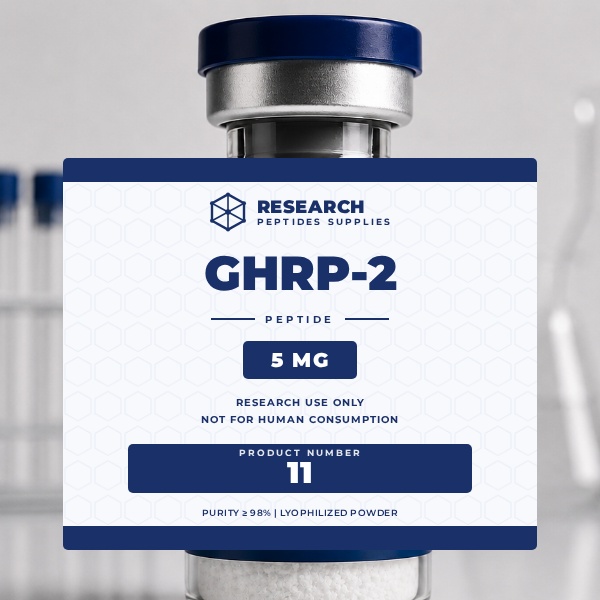
GHRP-2

$24.99

GHRP-2 — a synthetic hexapeptide (D-Ala-D-β-Nal-Ala-Trp-D-Phe-Lys-NH₂) that acts as a potent ghrelin receptor agonist and growth hormone releasing peptide. One of the most potent GHRPs studied, with significant GH, cortisol, and prolactin release in research models. Supplied lyophilized at ≥98% purity (HPLC-verified) with batch-specific COA. For research use only.

GHRP-2 Research Peptide — Scientific Overview

GHRP-2 (Growth Hormone Releasing Peptide 2; also known as KP 102 or Pralmorelin) is a synthetic hexapeptide that functions as an agonist at the ghrelin receptor (GHS-R1a) to stimulate growth hormone secretion. Developed following earlier GHRP research by Cyril Bowers and colleagues, GHRP-2 demonstrated superior GH-stimulatory potency compared to the original GHRP-1 compound. It has been studied extensively in pharmacological characterization studies and advanced into clinical trials by Kaken Pharmaceutical Company in Japan.

GHRP-2 is one of the most potent ghrelin receptor agonists in the GHRP class, producing strong GH secretion in both animal and human research subjects. Unlike Ipamorelin, which is highly selective for GH release, GHRP-2 also produces significant co-stimulation of cortisol and prolactin secretion — making it less selective but useful for research specifically investigating GHS-R1a pharmacology or comparing GHRP selectivity profiles across compounds. GHRP-2 has received regulatory approval in Japan (as Pralmorelin; Macimorelin precursor) as a diagnostic tool for GH deficiency testing.

Research Background

Published research with GHRP-2 includes extensive pharmacokinetic and pharmacodynamic characterization, comparison studies with other GHRPs (GHRP-6, Ipamorelin, Hexarelin), combination studies with GHRH analogs, and clinical research in GH-deficient and elderly subjects. It is used as a diagnostic agent in Japan for GH deficiency assessment and has generated significant data on GHS-R1a biology.

Key Research Areas

  • GHS-R1a Pharmacology: Ghrelin receptor binding, selectivity, and signaling pathway studies
  • GH Secretion Research: Potent GH stimulation and pulse pharmacodynamics in research models
  • GHRP Comparative Research: Selectivity comparison studies across GHRP class (GH vs cortisol vs prolactin)
  • Pituitary Research: Somatotroph stimulation and GH secretion mechanism studies
  • Diagnostic Research: GH deficiency provocative testing protocols
  • GH/Cortisol Interplay Research: Co-stimulation of multiple pituitary hormones via GHS-R1a

Technical Specifications

Parameter Value
Sequence D-Ala-D-β-Nal-Ala-Trp-D-Phe-Lys-NH₂
Molecular Weight 817.0 Da
Purity ≥98% (HPLC-verified)
Form Lyophilized powder, sealed under argon
Storage −20°C (long-term)
Documentation Batch-specific COA (HPLC + Mass Spec)

Storage & Handling (Research Laboratories)

Lyophilized GHRP-2 should be stored at −20°C for long-term preservation, protected from light and moisture. For short-term active research use, 4°C storage is acceptable for up to approximately 4 weeks. Minimize repeated freeze-thaw cycles. Follow standard laboratory peptide reconstitution and handling protocols for all experimental use.
Frequently Asked Questions — GHRP-2 Research

How does GHRP-2 compare to Ipamorelin in terms of selectivity?
GHRP-2 and Ipamorelin both act as ghrelin receptor (GHS-R1a) agonists to stimulate GH secretion, but they differ significantly in selectivity. Ipamorelin is highly selective — at standard research concentrations it stimulates GH release with minimal effect on cortisol and prolactin. GHRP-2 is less selective — it produces significant co-stimulation of cortisol and prolactin secretion alongside GH release. This makes Ipamorelin preferable when researchers want isolated GH effects, while GHRP-2 is used when studying broader GHS-R1a pharmacology or when the co-stimulation of multiple pituitary hormones is relevant to the research question.
What clinical approval does GHRP-2 (Pralmorelin) have?
GHRP-2, marketed as Pralmorelin (KP 102), received regulatory approval in Japan by Kaken Pharmaceutical Company for use as a diagnostic agent in the GH secretion test — a clinical test used to assess pituitary GH secretory capacity in patients suspected of having GH deficiency. This diagnostic approval makes GHRP-2 one of a small number of GHRPs with actual regulatory approval, providing well-characterized clinical pharmacokinetic and pharmacodynamic data valuable for research reference.
Why is cortisol co-stimulation relevant to GHRP-2 research?
The cortisol co-stimulation produced by GHRP-2 reflects activation of GHS-R1a receptors not only on pituitary somatotrophs (causing GH release) but also on corticotrophs (causing ACTH release, which stimulates cortisol production) and potentially via central hypothalamic mechanisms. Researchers studying GHRP-2 use this feature to investigate the multi-pituitary pathway effects of ghrelin receptor activation and to compare these effects with the cleaner GH-selectivity profile of Ipamorelin. The cortisol co-stimulation can also be a confounding variable in research designs where pure GH effects are needed.
Is GHRP-2 approved for human use in the USA?
GHRP-2/Pralmorelin is approved in Japan for diagnostic use but is not FDA-approved in the USA. Research Peptides Supplies supplies GHRP-2 for qualified laboratory research use only.
What documentation accompanies GHRP-2?
GHRP-2 from Research Peptides Supplies is verified at ≥98% purity by HPLC with identity confirmed by Mass Spectrometry. A batch-specific COA is provided with every order.
⚗️ Research Use Only: This product is strictly intended for qualified laboratory and scientific research use by trained professionals in appropriate laboratory settings. It is not intended for human or veterinary administration, therapeutic use, food supplement applications, or any use outside controlled research environments. Not for human consumption.
Shopping Cart
Scroll to Top