GHK-Cu Research Peptide — Scientific Overview
GHK-Cu (Glycyl-L-histidyl-L-lysine copper complex, also known as Copper Tripeptide-1) is a naturally occurring tripeptide found in human plasma, saliva, and urine. The peptide sequence Gly-His-Lys (GHK) has a high affinity for copper(II) ions, forming the GHK-Cu complex that has been the subject of extensive scientific investigation since Dr. Loren Pickart first characterized it in 1973 during liver cell studies at the University of California.
GHK-Cu is one of the most extensively studied copper peptides, with published research appearing in journals covering dermatology, regenerative biology, gene expression, and wound biology. The peptide is of particular interest to researchers studying the roles of copper in biological systems and the mechanisms by which small peptide-copper complexes modulate gene expression, cellular signaling, and tissue biology.
Research Background
Early research on GHK-Cu focused on its role in wound biology and tissue repair following its discovery in plasma. Subsequent decades of investigation have expanded the research scope to include gene expression modulation, anti-inflammatory signaling, antioxidant activity, and neurological pathway research. GHK-Cu has been shown in laboratory studies to influence the expression of hundreds of genes including those related to inflammation resolution, collagen synthesis, and antioxidant enzyme production. A 2012 analysis published in Genome Medicine suggested that GHK-Cu could reset expression of a broad range of genes related to tissue repair and inflammation.
Key Research Areas
- Gene Expression Research: Modulation of gene networks related to tissue repair, inflammation, and antioxidant response
- Wound Biology: Collagen synthesis, tissue remodeling, and cellular repair pathway studies
- Copper Biology: Role of copper complexes in biological systems and enzyme activity
- Anti-Inflammatory Research: Modulation of pro-inflammatory cytokine expression in vitro
- Dermatological Research: Skin biology, fibroblast behavior, and extracellular matrix studies
- Neurological Research: Nerve growth factor interactions and CNS biology investigations
- Antioxidant Research: Superoxide dismutase modulation and oxidative stress pathway studies
Technical Specifications
| Parameter |
Value |
| Sequence |
Gly-His-Lys · Cu²⁺ |
| Molecular Formula |
C14H23CuN6O4 |
| Molecular Weight |
340.8 Da (GHK peptide); 403.9 Da (GHK-Cu complex) |
| Purity |
≥98% (HPLC-verified) |
| Form |
Lyophilized powder, sealed under argon |
| Storage |
−20°C (long-term); 4°C (short-term, protected from light) |
| Documentation |
Batch-specific COA (HPLC + Mass Spec) |
Storage & Handling (Research Laboratories)
GHK-Cu lyophilized powder should be stored at −20°C in a sealed, light-protected container. Short-term storage at 4°C is acceptable for active research use. The copper complex is sensitive to light and should be protected from UV exposure. When handling copper peptide complexes in laboratory settings, standard metal complex handling protocols should be observed. Researchers should follow applicable laboratory safety procedures when working with copper-containing compounds.
Frequently Asked Questions — GHK-Cu Research
What is GHK-Cu and what makes it significant in research?
GHK-Cu (Glycyl-L-histidyl-L-lysine copper complex) is a naturally occurring tripeptide-copper complex found in human plasma, saliva, and urine. It has been studied since 1973 when Dr. Loren Pickart identified it as a biologically active compound in human albumin during liver biology research. Its significance in research lies in its ability to complex with copper and modulate a broad range of biological processes including gene expression, collagen synthesis, and inflammatory signaling pathways. It is one of the most-studied naturally occurring copper peptides.
What gene expression effects has GHK-Cu demonstrated in research studies?
A landmark 2012 study published in Genome Medicine analyzed GHK-Cu’s influence on gene expression using publicly available gene expression databases. The analysis suggested GHK-Cu influenced genes associated with tissue repair, anti-inflammatory responses, antioxidant enzyme production, and metabolic regulation. Separate in vitro studies have documented effects on collagen synthesis, MMP (matrix metalloproteinase) activity, TIMP expression, and inflammatory cytokine regulation in fibroblast and epithelial cell models. These findings are from laboratory studies and should not be interpreted as clinical evidence of therapeutic effects.
How does GHK-Cu bind copper and why is copper relevant to its research applications?
The GHK tripeptide forms a stable 3:1 complex with Cu²⁺ through coordination bonds involving the nitrogen atoms of the glycine amine, histidine imidazole, and the deprotonated amide nitrogen. Copper is an essential cofactor for numerous enzymes including superoxide dismutase, cytochrome c oxidase, and lysyl oxidase — all of which are relevant to antioxidant defense, energy metabolism, and collagen crosslinking respectively. Researchers study GHK-Cu partly to understand how small peptide-metal complexes can serve as copper delivery vehicles to copper-dependent enzymes and biological processes.
What is the difference between GHK and GHK-Cu?
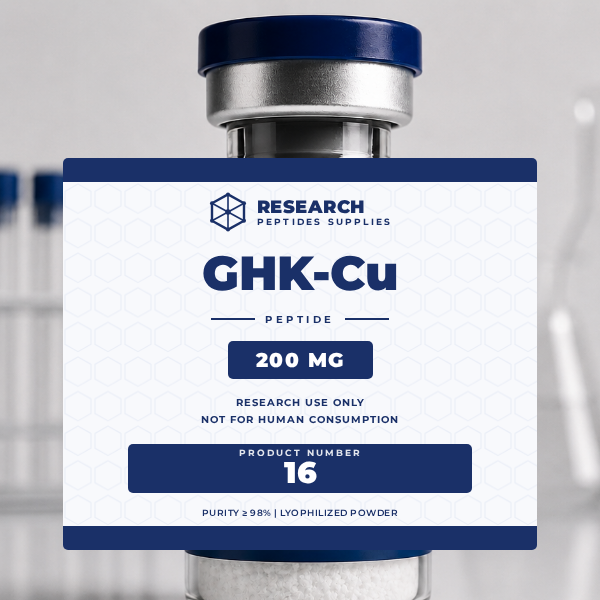
GHK refers to the tripeptide sequence alone (Gly-His-Lys) without copper coordination. GHK-Cu refers to the copper-complexed form where Cu²⁺ is coordinated to the peptide. In research, the two forms can exhibit different biological activities — many of the more pronounced effects documented in published studies involve the copper-complexed form. Research Peptides Supplies supplies GHK-Cu as the copper-complexed tripeptide. Researchers should specify which form is needed based on their experimental protocol.
Is GHK-Cu safe for human use or consumption?
GHK-Cu supplied by Research Peptides Supplies is intended strictly for qualified laboratory and scientific research use only. It is not approved for human therapeutic use, not a food supplement, and not intended for consumption or self-administration in any form. Research personnel should follow all applicable laboratory safety protocols when handling copper-containing peptide compounds. GHK-Cu in cosmetic formulations is a separate regulatory category — our research-grade lyophilized product is not a cosmetic ingredient and should not be used as one.
⚗️ Research Use Only: This product is strictly intended for qualified laboratory and scientific research use by trained professionals in appropriate laboratory settings. It is not intended for human or veterinary administration, therapeutic use, food supplement applications, or any use outside controlled research environments. Not for human consumption.