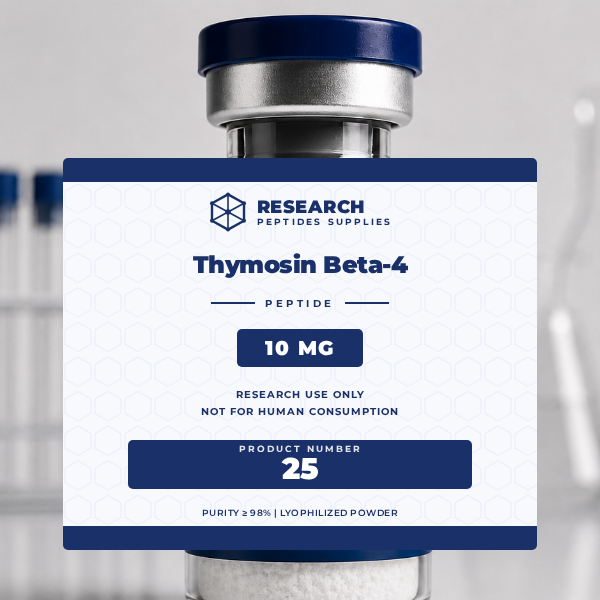
Thymosin Beta-4 (TB4) Research Peptide — Scientific Overview
Thymosin Beta-4 (Tβ4) is a naturally occurring 43-amino-acid protein first isolated from calf thymus tissue by Low and Goldstein in 1981. It is one of the most abundant intracellular peptides in mammalian cells (particularly platelets and macrophages), present at micromolar concentrations in the cytoplasm and extracellular fluids. Unlike many research peptides, Thymosin Beta-4 is a well-characterized endogenous protein with established physiological roles — most prominently as the major G-actin sequestering protein that regulates the cellular pool of unpolymerized actin available for cytoskeletal dynamics.
Tβ4’s primary molecular function is to sequester G-actin (monomeric actin) in a 1:1 complex, thereby regulating the dynamic balance between G-actin and F-actin (filamentous actin). This regulation of actin polymerization influences virtually every actin-dependent cellular process including cell motility, shape, division, and phagocytosis. In addition to its cytoskeletal role, Tβ4 contains an active domain (LKKTET) that mediates many of its extracellular activities including promotion of angiogenesis, wound healing, and cardiac progenitor cell activation.
Research Background
The biomedical research profile of Thymosin Beta-4 has expanded dramatically since the early 2000s when its extracellular and secreted forms were recognized as potent modulators of tissue repair and angiogenesis. Regeneration Technologies (RegeneRx) has conducted clinical trials with recombinant Tβ4 in wound healing, dry eye syndrome, and cardiac protection, providing a substantial human safety and pharmacokinetic database that supports its research use.
Key Research Areas
- Actin Biology Research: G-actin sequestration, cytoskeletal dynamics, and actin polymerization studies
- Wound Healing Research: Tissue repair pathway studies and wound closure biology
- Cardiac Research: Cardiac progenitor cell activation and post-infarction repair studies
- Angiogenesis Research: Vascular endothelial cell migration and new vessel formation studies
- Anti-Inflammatory Research: NF-κB pathway modulation and inflammatory mediator studies
- Neurological Research: Neuroprotective effects and neural repair pathway biology
Technical Specifications
| Parameter | Value |
|---|---|
| Sequence | 43 amino acids (Ser-Asp-Lys-Pro-Asp-Met-Ala-Glu-Ile-Glu-Lys-Phe-Asp-Lys-Ser-Lys-Leu-Lys-Lys-Thr-Glu-Thr-Gln-Glu-Lys-Asn-Pro-Leu-Pro-Ser-Lys-Glu-Thr-Ile-Glu-Gln-Glu-Lys-Gln-Ala-Gly-Glu-Ser) |
| Molecular Weight | 4963.5 Da |
| Purity | ≥98% (HPLC-verified) |
| Form | Lyophilized powder, sealed under argon |
| Storage | −20°C (long-term) |
| Documentation | Batch-specific COA (HPLC + Mass Spec) |
Storage & Handling (Research Laboratories)
Lyophilized Thymosin Beta-4 (TB4) should be stored at −20°C for long-term preservation, protected from light and moisture. For short-term active research use, 4°C storage is acceptable for up to approximately 4 weeks. Minimize repeated freeze-thaw cycles. Follow standard laboratory peptide reconstitution and handling protocols for all experimental use.