Retatrutide Research Peptide — Scientific Overview
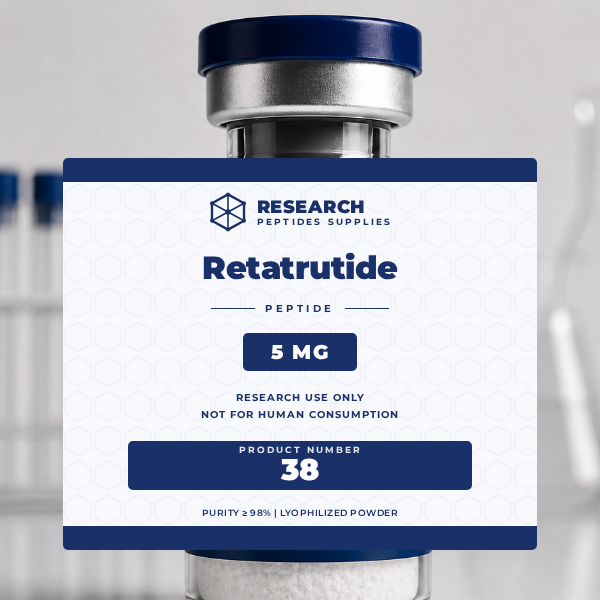
Retatrutide (LY3437943) is a synthetic peptide triagonist developed by Eli Lilly that activates three metabolic hormone receptors simultaneously: the glucose-dependent insulinotropic polypeptide receptor (GIPR), the glucagon-like peptide-1 receptor (GLP-1R), and the glucagon receptor (GCGR). This triple receptor agonism builds upon dual GIP/GLP-1 agonists (tirzepatide) by adding glucagon receptor activation, which increases energy expenditure and hepatic fat mobilization alongside the appetite-suppressing and insulin-sensitizing effects of GIP and GLP-1.
Retatrutide (LY3437943) is a synthetic peptide triagonist developed by Eli Lilly that activates three metabolic hormone receptors simultaneously: the glucose-dependent insulinotropic polypeptide receptor (GIPR), the glucagon-like peptide-1 receptor (GLP-1R), and the glucagon receptor (GCGR). This triple receptor agonism builds upon dual GIP/GLP-1 agonists (tirzepatide) by adding glucagon receptor activation, which increases energy expenditure and hepatic fat mobilization alongside the appetite-suppressing and insulin-sensitizing effects of GIP and GLP-1. Phase II clinical trial results published in the New England Journal of Medicine (Jastreboff et al., 2023) reported a mean 24.2% body weight reduction at 48 weeks with the highest dose — the greatest weight loss percentage reported for any pharmacological agent in a clinical trial at the time of publication. The Phase III TRIUMPH program is ongoing. Adding glucagon receptor agonism to GIP/GLP-1 agonism is hypothesized to increase thermogenesis, promote hepatic glycogenolysis, and drive greater energy expenditure than GLP-1 alone.
Research Background
Phase II clinical trial results published in the New England Journal of Medicine (Jastreboff et al., 2023) reported a mean 24.2% body weight reduction at 48 weeks with the highest dose — the greatest weight loss percentage reported for any pharmacological agent in a clinical trial at the time of publication. The Phase III TRIUMPH program is ongoing. Adding glucagon receptor agonism to GIP/GLP-1 agonism is hypothesized to increase thermogenesis, promote hepatic glycogenolysis, and drive greater energy expenditure than GLP-1 alone.
Key Research Areas
- Triple Receptor Agonism Research: GIPR + GLP-1R + GCGR simultaneous activation and signaling pathway studies
- Obesity Research: Energy balance, satiety, and adipose tissue biology in research models
- Metabolic Research: Glucose metabolism, insulin secretion, and glycemic regulation
- Hepatic Research: Non-alcoholic fatty liver disease (NAFLD) and hepatic lipid metabolism
- Energy Expenditure Research: Glucagon-mediated thermogenesis and metabolic rate modulation
- Comparative Research: Triagonist vs. dual agonist mechanism comparison studies
Technical Specifications
| Parameter | Value |
|---|---|
| Classification | GIP/GLP-1/Glucagon triple receptor agonist (triagonist) |
| Developer | Eli Lilly (LY3437943) |
| Purity | ≥98% (HPLC-verified) |
| Form | Lyophilized powder, sealed under argon |
| Storage | −20°C (long-term) |
| Documentation | Batch-specific COA (HPLC + Mass Spec) |
Storage & Handling (Research Laboratories)
Lyophilized Retatrutide should be stored at −20°C for long-term preservation, protected from light and moisture. For short-term active research use, 4°C storage is acceptable for up to approximately 4 weeks. Minimize repeated freeze-thaw cycles. Follow standard laboratory peptide reconstitution and handling protocols for all experimental use.