Mod GRF 1-29 Research Peptide — Scientific Overview
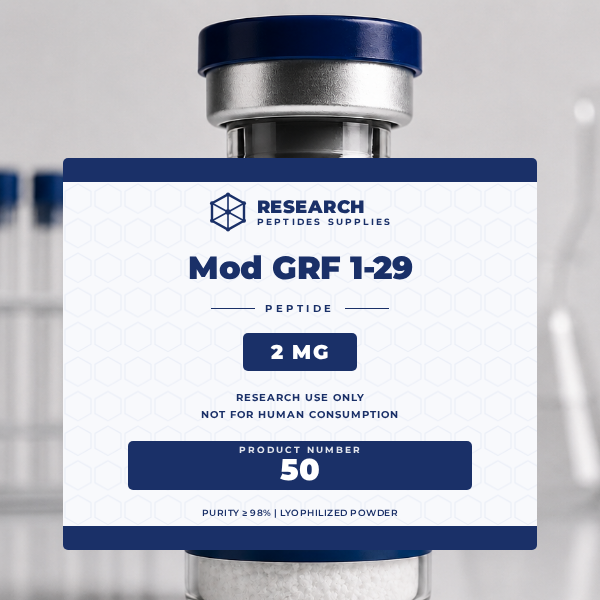
Mod GRF 1-29 (Modified GRF 1-29, also known as CJC-1295 without DAC) is a synthetic 29-amino-acid analog of endogenous growth hormone-releasing hormone (GHRH). The peptide was developed by modifying the first 29 amino acids of native GHRH (GRF 1-29) at four amino acid positions (Tyr1→His, Ala2→AIB, Gln8→Ala, Ala15→Gln, Leu27→Leu) to improve enzymatic stability against proteolytic degradation while retaining full GHRH receptor agonism. The result is a significantly more stable GHRH analog with an extended half-life compared to native GRF 1-29.
Mod GRF 1-29 (Modified GRF 1-29, also known as CJC-1295 without DAC) is a synthetic 29-amino-acid analog of endogenous growth hormone-releasing hormone (GHRH). The peptide was developed by modifying the first 29 amino acids of native GHRH (GRF 1-29) at four amino acid positions (Tyr1→His, Ala2→AIB, Gln8→Ala, Ala15→Gln, Leu27→Leu) to improve enzymatic stability against proteolytic degradation while retaining full GHRH receptor agonism. The result is a significantly more stable GHRH analog with an extended half-life compared to native GRF 1-29. Native GHRH (GRF 1-29) has a very short plasma half-life (< 2 minutes) due to rapid cleavage by dipeptidyl peptidase-4 (DPP-4) and other serum peptidases. Mod GRF 1-29's four stabilizing amino acid substitutions substantially extend its plasma half-life (approximately 30 minutes), enabling research models that require sustained GHRH receptor stimulation without continuous infusion. It is distinguished from CJC-1295 with DAC (drug affinity complex) by lacking the lysine-DAC modification that enables ultra-long-acting GH axis stimulation — Mod GRF 1-29 produces a more physiological, pulsatile GH release pattern suitable for pulsatile GH axis research.
Research Background
Native GHRH (GRF 1-29) has a very short plasma half-life (< 2 minutes) due to rapid cleavage by dipeptidyl peptidase-4 (DPP-4) and other serum peptidases. Mod GRF 1-29's four stabilizing amino acid substitutions substantially extend its plasma half-life (approximately 30 minutes), enabling research models that require sustained GHRH receptor stimulation without continuous infusion. It is distinguished from CJC-1295 with DAC (drug affinity complex) by lacking the lysine-DAC modification that enables ultra-long-acting GH axis stimulation — Mod GRF 1-29 produces a more physiological, pulsatile GH release pattern suitable for pulsatile GH axis research.
Key Research Areas
- GH Axis Research: Pulsatile GH secretion, GHRH receptor signaling, and somatotroph biology
- Growth Hormone Biology: GH secretion dynamics, IGF-1 induction, and GH pulse amplitude studies
- Body Composition Research: Lean mass, adipose tissue, and GH/IGF-1 axis interaction studies
- GHRH Receptor Research: GHRH receptor pharmacology, G-protein coupling, and downstream signaling
- Stability Research: Protease-resistant peptide design and DPP-4 resistance studies
- Pituitary Research: Somatotroph cell function and anterior pituitary GH secretion biology
Technical Specifications
| Parameter | Value |
|---|---|
| Sequence | His-AIB-Asp-Ala-Ile-Phe-Thr-Gln-Ser-Tyr-Arg-Lys-Val-Leu-Ala-Gln-Leu-Ser-Ala-Arg-Lys-Leu-Leu-Gln-Asp-Ile-Leu-Ser-Arg-NH₂ (29 AA) |
| Molecular Weight | ~3367 Da |
| Purity | ≥98% (HPLC-verified) |
| Form | Lyophilized powder, sealed under argon |
| Storage | −20°C (long-term) |
| Documentation | Batch-specific COA (HPLC + Mass Spec) |
Storage & Handling (Research Laboratories)
Lyophilized Mod GRF 1-29 should be stored at −20°C for long-term preservation, protected from light and moisture. For short-term active research use, 4°C storage is acceptable for up to approximately 4 weeks. Minimize repeated freeze-thaw cycles. Follow standard laboratory peptide reconstitution and handling protocols for all experimental use.