⌕♙🛒
,

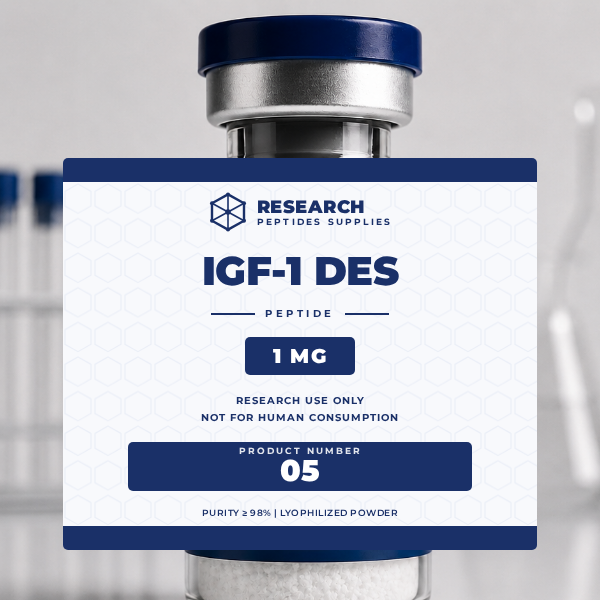
IGF-1 DES

$54.99

IGF-1 DES — the des(1-3) truncation of IGF-1 — the naturally occurring form missing the first three N-terminal amino acids. This truncation eliminates IGFBP-3 and -5 binding but preserves IGF-1R affinity, creating a potent, more locally bioavailable form of IGF-1. Supplied lyophilized at ≥98% purity (HPLC-verified) with batch-specific COA. For research use only.

IGF-1 DES Research Peptide — Scientific Overview

IGF-1 DES (des(1-3)IGF-1) is a naturally occurring truncated variant of IGF-1 that lacks the first three N-terminal amino acids (Gly-Pro-Glu) of full-length IGF-1. This truncated form is produced naturally in the brain, gut, and other tissues through local enzymatic cleavage of the full-length peptide. The deletion of the first three amino acids eliminates the IGF-1 DES variant’s ability to bind IGFBP-3 and IGFBP-5 (though binding to IGFBP-2 and IGFBP-6 is partially retained) while maintaining full affinity for the IGF-1 receptor.

The natural occurrence of IGF-1 DES in specific tissues — particularly the brain and gut — and its structural simplicity make it an interesting research tool. Unlike IGF-1 LR3 (an artificial analog designed to reduce IGFBP binding), IGF-1 DES is a naturally occurring truncation that arises from endogenous protease activity. This distinction is relevant for research examining physiological IGF-1 biology in tissues where des(1-3)IGF-1 processing is significant.

Research Background

Research with IGF-1 DES has examined its roles in gut biology (where it is naturally abundant), brain neurodevelopment and neuroprotection, skeletal muscle anabolism, and cell culture applications where IGFBP-independent IGF-1R activation is needed. Comparative studies between full-length IGF-1, IGF-1 LR3, and IGF-1 DES provide insights into the roles of binding proteins in controlling IGF-1’s biological effects.

Key Research Areas

  • Gut Biology Research: Natural des-IGF-1 role in intestinal growth, repair, and epithelial biology
  • Brain Research: Neurogenesis, neuroprotection, and brain-specific IGF processing studies
  • Muscle Biology Research: Skeletal muscle anabolic studies with IGFBP-independent IGF-1R activation
  • IGFBP Biology Research: Binding protein-free IGF-1R activation and paracrine IGF-1 biology
  • Cell Culture Research: Serum-free IGF-1R stimulation and mitogenic studies
  • Structure-Activity Research: Comparison of truncation effects on IGFBP binding vs. receptor binding

Technical Specifications

Parameter Value
Classification Naturally occurring des(1-3)IGF-1 truncation variant
Molecular Weight ~7.5 kDa
Purity ≥97% (SDS-PAGE / RP-HPLC verified)
Form Lyophilized, recombinant
Storage −20°C (long-term)
Documentation Batch-specific COA (SDS-PAGE + activity data)

Storage & Handling (Research Laboratories)

Lyophilized IGF-1 DES should be stored at −20°C for long-term preservation, protected from light and moisture. For short-term active research use, 4°C storage is acceptable for up to approximately 4 weeks. Minimize repeated freeze-thaw cycles. Follow standard laboratory peptide reconstitution and handling protocols for all experimental use.
Frequently Asked Questions — IGF-1 DES Research

What is the key difference between IGF-1 DES and IGF-1 LR3?
Both IGF-1 DES and IGF-1 LR3 have reduced IGFBP binding compared to native IGF-1, but through different mechanisms. IGF-1 DES occurs naturally — it is produced by endogenous proteolytic cleavage of the first three N-terminal amino acids of native IGF-1, primarily in the brain and gut. IGF-1 LR3 is an artificial analog designed specifically to reduce IGFBP binding through an N-terminal extension and Glu3→Arg substitution. IGF-1 LR3 shows more complete IGFBP resistance (~1000-fold reduction) compared to IGF-1 DES, which retains partial IGFBP-2 binding.
Where does IGF-1 DES occur naturally in the body?
IGF-1 DES is produced naturally in the brain (particularly during fetal development), the gut (where it may play a role in intestinal epithelial growth and repair), and in other tissues through local protease activity. Brain-derived IGF-1 DES is thought to contribute significantly to local CNS IGF-1R signaling because it is less sequestered by local IGFBPs than full-length IGF-1. The gut is another significant site of IGF-1 DES production, where it may regulate intestinal epithelial cell proliferation and recovery from mucosal injury.
Why is the first three amino acid difference pharmacologically significant?
The N-terminal tripeptide Gly-Pro-Glu of native IGF-1 is critical for IGFBP-3 and IGFBP-5 binding. These two binding proteins account for the majority of circulating IGF-1’s protein-bound fraction. Removing these three amino acids eliminates this binding while leaving the core receptor-binding domain of IGF-1 intact. The result is a form of IGF-1 that has similar IGF-1R affinity as native IGF-1 but dramatically greater free bioavailability — particularly in tissues where IGFBP-3 and IGFBP-5 are expressed.
Is IGF-1 DES approved for human use?
No. IGF-1 DES is not approved for human therapeutic use. Research Peptides Supplies supplies it for qualified laboratory research use only.
What documentation comes with IGF-1 DES?
IGF-1 DES from Research Peptides Supplies is verified by SDS-PAGE and RP-HPLC, with activity data included where available. A batch-specific COA documenting lot number, purity, and analysis methodology is provided.
⚗️ Research Use Only: This product is strictly intended for qualified laboratory and scientific research use by trained professionals in appropriate laboratory settings. It is not intended for human or veterinary administration, therapeutic use, food supplement applications, or any use outside controlled research environments. Not for human consumption.
Shopping Cart
Scroll to Top