⌕♙🛒
,

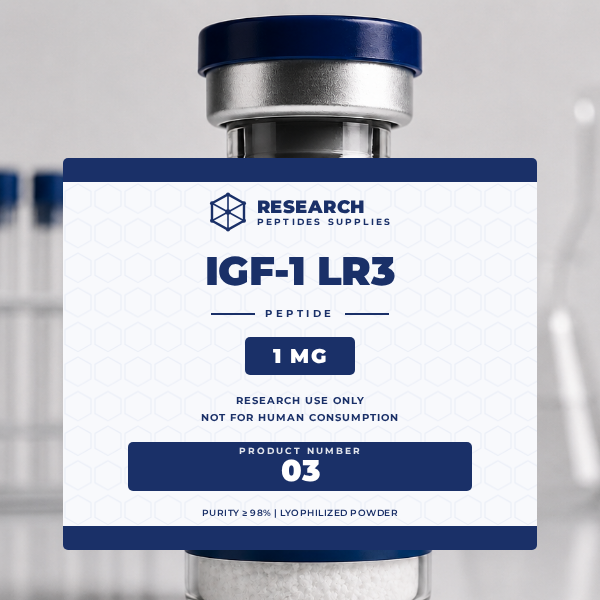
IGF-1 LR3

$59.99

IGF-1 LR3 — a long-acting recombinant IGF-1 analog with an N-terminal extension (Arg-Met) and Glu3→Arg substitution that dramatically reduces binding to IGF binding proteins (IGFBPs). This results in a ~3-fold longer half-life and significantly enhanced bioavailability in research models. Supplied lyophilized at ≥98% purity (HPLC-verified) with batch-specific COA. For research use only.

IGF-1 LR3 Research Peptide — Scientific Overview

IGF-1 LR3 (Long Arg3 IGF-1) is a modified recombinant analog of insulin-like growth factor 1 that incorporates two structural changes to reduce IGFBP binding: (1) an N-terminal 13-amino-acid extension (Met-Arg₁₂) that sterically inhibits IGFBP-3 binding, and (2) substitution of glutamic acid at position 3 with arginine (Glu3→Arg). These modifications reduce IGF-1 LR3’s affinity for IGF binding proteins by approximately 1000-fold compared to native IGF-1, while maintaining similar affinity for the IGF-1 receptor (IGF-1R).

The biological significance of IGFBP binding lies in the fact that greater than 99% of circulating native IGF-1 is bound to one of six IGF binding proteins (IGFBP-1 through IGFBP-6), primarily IGFBP-3. This binding dramatically limits the bioavailability of free (active) IGF-1. IGF-1 LR3 effectively bypasses this binding protein sequestration, making vastly more IGF-1R-active peptide available in research models. The result is an approximately 3-fold longer plasma half-life and dramatically enhanced mitogenic and anabolic potency per mole compared to native IGF-1 in cell culture and animal research.

Research Background

IGF-1 LR3 is widely used in cell biology research as the preferred IGF-1 isoform for cell culture studies — particularly for serum-free media where achieving physiological IGF-1 pathway activation is difficult with native IGF-1 due to IGFBP interference. In vivo animal research has used IGF-1 LR3 to study sustained IGF-1R signaling, muscle hypertrophy, and metabolic effects with reduced injection frequency compared to native IGF-1.

Key Research Areas

  • Cell Culture Research: Serum-free media IGF-1 receptor activation and mitogenic studies
  • Muscle Biology Research: Skeletal muscle hypertrophy and protein synthesis studies with prolonged IGF-1 signaling
  • IGFBP Biology Research: Binding protein interference studies and free vs. bound IGF-1 bioavailability
  • Metabolic Research: Insulin-sensitization, glucose metabolism, and mTOR pathway studies
  • Cancer Biology Research: IGF-1R signaling in cancer proliferation and resistance models
  • In Vitro Pharmacology: Reference IGF-1 analog for receptor binding and signaling studies

Technical Specifications

Parameter Value
Classification IGF-1 analog; Glu3→Arg + N-terminal Met-Arg₁₂ extension
Molecular Weight ~9.1 kDa
Purity ≥97% (SDS-PAGE / RP-HPLC verified)
Form Lyophilized, recombinant E. coli
Storage −20°C (long-term); 4°C (short-term)
Documentation Batch-specific COA (SDS-PAGE + activity data)

Storage & Handling (Research Laboratories)

Lyophilized IGF-1 LR3 should be stored at −20°C for long-term preservation, protected from light and moisture. For short-term active research use, 4°C storage is acceptable for up to approximately 4 weeks. Minimize repeated freeze-thaw cycles. Follow standard laboratory peptide reconstitution and handling protocols for all experimental use.
Frequently Asked Questions — IGF-1 LR3 Research

Why is IGF-1 LR3 preferred over native IGF-1 in cell culture research?
In cell culture systems, IGF-1 LR3 is typically preferred over native IGF-1 because cell culture media (especially serum-free formulations) may contain IGF binding proteins that bind and sequester native IGF-1, reducing receptor availability. IGF-1 LR3’s ~1000-fold reduced IGFBP affinity means essentially all added peptide remains free and receptor-active — providing more predictable, quantifiable IGF-1R stimulation. In serum-containing media, fetal bovine serum introduces IGFBP-3 that similarly sequesters native IGF-1. Researchers use IGF-1 LR3 to achieve consistent IGF-1R pathway activation in cell models.
What is the IGFBP system and why does it matter for IGF-1 research?
The insulin-like growth factor binding protein (IGFBP) system consists of six secreted binding proteins (IGFBP-1 to 6) that bind IGF-1 and IGF-2 with high affinity in the circulation and in the extracellular space. Over 99% of circulating IGF-1 is bound to IGFBPs (primarily IGFBP-3 in a ternary complex with ALS). Bound IGF-1 has a plasma half-life of ~15-20 hours, while free IGF-1 has a half-life of only ~10-12 minutes. IGFBPs serve as reservoir, transport, and delivery mechanisms for IGF-1, but they also limit immediate receptor availability. Understanding and controlling IGFBP binding is critical for interpreting IGF-1 research data.
How much more potent is IGF-1 LR3 than native IGF-1 in research models?
In cell-based mitogenesis assays with IGFBP-containing media, IGF-1 LR3 typically shows approximately 2-3 times greater potency than native IGF-1 due to its IGFBP resistance. In serum-free, IGFBP-free conditions, IGF-1 LR3 shows similar potency to native IGF-1 at the IGF-1R level. The practical enhancement depends heavily on the specific experimental conditions — the IGFBP concentration in the medium determines the extent of native IGF-1 sequestration. Researchers quantify this empirically for their specific cell system.
Is IGF-1 LR3 approved for human use?
No. IGF-1 LR3 is a research analog not approved for any human therapeutic use. It differs from pharmaceutical mecasermin (Increlex) which uses native IGF-1. Research Peptides Supplies supplies IGF-1 LR3 for qualified laboratory research use only.
What documentation comes with IGF-1 LR3?
IGF-1 LR3 from Research Peptides Supplies is verified by SDS-PAGE and RP-HPLC with biological activity data included in the batch COA. Lot number, purity result, and activity assessment are documented.
⚗️ Research Use Only: This product is strictly intended for qualified laboratory and scientific research use by trained professionals in appropriate laboratory settings. It is not intended for human or veterinary administration, therapeutic use, food supplement applications, or any use outside controlled research environments. Not for human consumption.
Shopping Cart
Scroll to Top