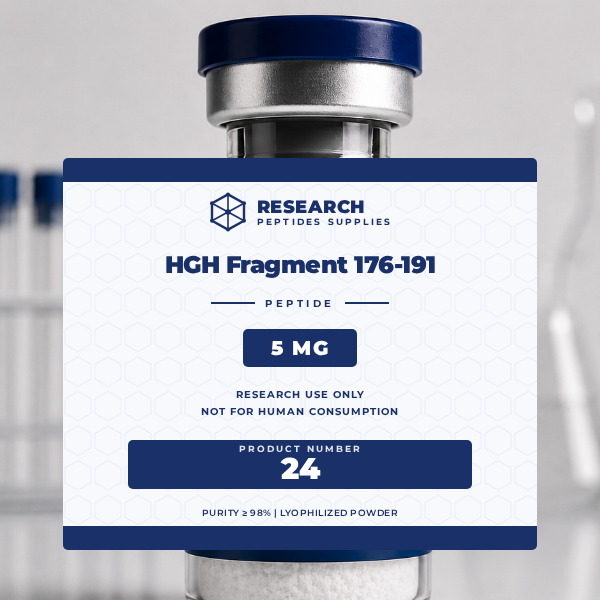
HGH Fragment 176-191 Research Peptide — Scientific Overview
HGH Fragment 176-191 is a synthetic 16-amino-acid peptide corresponding to amino acid positions 176-191 of the human growth hormone sequence. This C-terminal fragment isolates the portion of hGH that has been associated with the hormone’s lipolytic (fat-mobilizing) activity in research models. The fragment contains a disulfide bond between Cys182 and Cys189 that is present in the native hGH structure and contributes to the peptide’s three-dimensional conformation and bioactivity.
The rationale for studying isolated GH domain fragments like hGH(176-191) stems from research demonstrating that growth hormone’s diverse biological effects are mediated by different structural domains. The N-terminal region of GH mediates growth-promoting, diabetogenic, and IGF-1-inducing effects through classical GH receptor activation. The C-terminal 176-191 region, in contrast, appears to stimulate lipolysis through mechanisms that do not require classical GH receptor activation, making it possible to study fat-mobilizing biology without growth promotion or insulin resistance confounds.
Research Background
Research with hGH(176-191) in rodent models has documented stimulation of lipolysis in isolated adipocytes, inhibition of lipogenesis in fat tissue, and reductions in body fat mass without the growth-promoting effects of full hGH. The fragment has been proposed to act through β-adrenergic receptor mechanisms in adipose tissue. Its study has contributed to understanding the structure-activity relationships within the GH molecule and the potential for fragment-based approaches to metabolic research.
Key Research Areas
- Lipolysis Research: Adipocyte fat mobilization and anti-lipogenic studies in cell and animal models
- GH Domain Research: Structure-activity relationship studies of C-terminal hGH fragment bioactivity
- Adipose Biology Research: Fat tissue biology and triglyceride metabolism studies
- Metabolic Research: Body composition and fat mass modulation in animal metabolic models
- β-Adrenergic Research: β3-adrenergic receptor pathway activation in adipose tissue
- Comparative Research: GH fragment vs. full hGH lipolytic mechanism comparison
Technical Specifications
| Parameter | Value |
|---|---|
| Sequence | Leu-Arg-Ile-Val-Gln-Cys-Arg-Ser-Val-Glu-Gly-Ser-Cys-Gly-Phe (aa 176-191 of hGH) |
| Molecular Weight | ~1818 Da (includes disulfide bond) |
| Purity | ≥98% (HPLC-verified) |
| Form | Lyophilized powder, sealed under argon |
| Storage | −20°C (long-term) |
| Documentation | Batch-specific COA (HPLC + Mass Spec) |
Storage & Handling (Research Laboratories)
Lyophilized HGH Fragment 176-191 should be stored at −20°C for long-term preservation, protected from light and moisture. For short-term active research use, 4°C storage is acceptable for up to approximately 4 weeks. Minimize repeated freeze-thaw cycles. Follow standard laboratory peptide reconstitution and handling protocols for all experimental use.