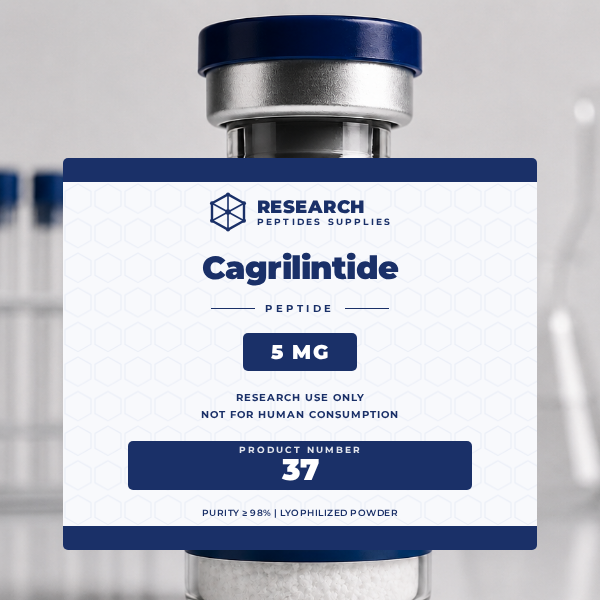
Cagrilintide Research Peptide — Scientific Overview
Cagrilintide is a long-acting synthetic amylin analog developed by Novo Nordisk as part of the CagriSema combination research program. Amylin (islet amyloid polypeptide, IAPP) is a 37-amino-acid peptide co-secreted with insulin from pancreatic β-cells that plays a complementary role to GLP-1 in regulating post-meal glucose levels, slowing gastric emptying, suppressing glucagon, and promoting satiety.
Cagrilintide is a long-acting synthetic amylin analog developed by Novo Nordisk as part of the CagriSema combination research program. Amylin (islet amyloid polypeptide, IAPP) is a 37-amino-acid peptide co-secreted with insulin from pancreatic β-cells that plays a complementary role to GLP-1 in regulating post-meal glucose levels, slowing gastric emptying, suppressing glucagon, and promoting satiety. In Phase II and III clinical trials, Cagrilintide demonstrated significant weight loss and glucose-lowering effects as a monotherapy and substantial additional benefit when combined with semaglutide (as CagriSema). Research interest centers on its complementary mechanism to GLP-1 receptor agonists — the amylin receptor pathway provides additional satiety and glycemic regulation through pathways independent of GLP-1R, potentially enabling superior weight loss when the two classes are combined.
Research Background
In Phase II and III clinical trials, Cagrilintide demonstrated significant weight loss and glucose-lowering effects as a monotherapy and substantial additional benefit when combined with semaglutide (as CagriSema). Research interest centers on its complementary mechanism to GLP-1 receptor agonists — the amylin receptor pathway provides additional satiety and glycemic regulation through pathways independent of GLP-1R, potentially enabling superior weight loss when the two classes are combined.
Key Research Areas
- Amylin Biology Research: Amylin receptor pharmacology and pancreatic β-cell biology
- Weight Regulation Research: Satiety pathway modulation and long-term energy balance studies
- Metabolic Research: Glucose metabolism, insulin secretion, and glycemic regulation
- Combination Research: Amylin + GLP-1 pathway synergy in metabolic models
- Gastric Motility Research: Gastric emptying rate modulation and meal-related studies
- Glucagon Regulation Research: Post-prandial glucagon suppression and α-cell biology
Technical Specifications
| Parameter | Value |
|---|---|
| Classification | Long-acting amylin analog (subcutaneous administration in clinical research) |
| Target | Amylin receptor (AMY₁, AMY₂, AMY₃) |
| Purity | ≥98% (HPLC-verified) |
| Form | Lyophilized powder, sealed under argon |
| Storage | −20°C (long-term) |
| Documentation | Batch-specific COA (HPLC + Mass Spec) |
Storage & Handling (Research Laboratories)
Lyophilized Cagrilintide should be stored at −20°C for long-term preservation, protected from light and moisture. For short-term active research use, 4°C storage is acceptable for up to approximately 4 weeks. Minimize repeated freeze-thaw cycles. Follow standard laboratory peptide reconstitution and handling protocols for all experimental use.