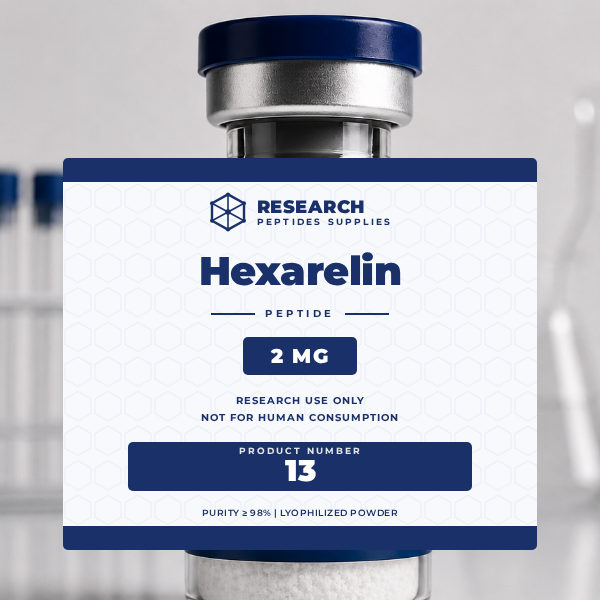
Hexarelin Research Peptide — Scientific Overview
Hexarelin (His-D-2-MeTrp-Ala-Trp-D-Phe-Lys-NH₂) is a synthetic hexapeptide GHRP developed as an improvement over GHRP-6, featuring a 2-methyl-tryptophan at position 2 that confers enhanced metabolic stability and potency. Hexarelin is one of the most potent GHS-R1a agonists in the GHRP class, producing strong GH stimulation in research models with corresponding cortisol and prolactin co-stimulation. Hexarelin has been advanced into clinical trials by Europeptides (Italy) and has accumulated clinical pharmacokinetic and pharmacodynamic data in human subjects.
What makes Hexarelin uniquely interesting beyond its GH-stimulatory profile is its documented ability to interact with cardiac receptors independent of GH — specifically the CD36 receptor (scavenger receptor B-II) and potentially the GHS-R1a receptors expressed in cardiac tissue. This dual mechanism means that Hexarelin’s cardiac research effects may persist even in GH-deficient animals and may occur through pathways that do not require GH or IGF-1 mediation, making it a particularly valuable tool for cardiac biology research.
Research Background
Published Hexarelin research spans GH secretagogue pharmacology, cardiac protection studies in ischemia-reperfusion models, anti-fibrotic effects in cardiac remodeling research, and CD36/GHS-R1a receptor biology in cardiac tissue. Clinical studies have characterized its pharmacokinetics and GH-stimulatory effects in human subjects, establishing it as one of the best-characterized GHRP compounds.
Key Research Areas
- Cardiac Research: Cardioprotection, fibrosis reduction, and CD36/GHS-R1a cardiac receptor biology
- GH Secretagogue Research: Potent GHS-R1a agonism and GH secretion pharmacodynamics
- CD36 Biology Research: Scavenger receptor B-II interaction and non-GHS-R1a mechanisms
- Ischemia Research: Cardiac ischemia-reperfusion protection studies in preclinical models
- Cardiac Remodeling Research: Anti-fibrotic effects and post-infarction remodeling studies
- Receptor Pharmacology: Dual receptor (GHS-R1a + CD36) profile and mechanism dissection studies
Technical Specifications
| Parameter |
Value |
| Sequence |
His-D-2-MeTrp-Ala-Trp-D-Phe-Lys-NH₂ |
| Molecular Weight |
887.1 Da |
| Purity |
≥98% (HPLC-verified) |
| Form |
Lyophilized powder, sealed under argon |
| Storage |
−20°C (long-term) |
| Documentation |
Batch-specific COA (HPLC + Mass Spec) |
Storage & Handling (Research Laboratories)
Lyophilized Hexarelin should be stored at −20°C for long-term preservation, protected from light and moisture. For short-term active research use, 4°C storage is acceptable for up to approximately 4 weeks. Minimize repeated freeze-thaw cycles. Follow standard laboratory peptide reconstitution and handling protocols for all experimental use.
Frequently Asked Questions — Hexarelin Research
What makes Hexarelin’s cardiac effects unique among GHRPs?
Hexarelin is the only GHRP for which substantial evidence of GH-independent cardiac effects has been published. Research has demonstrated that Hexarelin can reduce myocardial ischemia-reperfusion injury and prevent cardiac fibrosis even in hypophysectomized (pituitary-removed) animals — meaning the cardiac effects persist in the absence of GH. This indicates that Hexarelin acts directly on cardiac tissue through receptors other than GHS-R1a. Subsequent research identified CD36 (a scavenger receptor abundant in cardiac muscle) as a Hexarelin binding partner that mediates GH-independent cardiac effects — a unique property not shared by other GHRPs studied.
How does Hexarelin compare to other GHRPs in potency?
Hexarelin is generally considered one of the most potent GHS-R1a agonists in the GHRP class. Comparative studies have shown that Hexarelin produces greater GH secretion per mole compared to GHRP-6 and GHRP-2 in both animal and human research. The enhanced potency is attributed to the 2-methyl-tryptophan modification at position 2, which improves receptor binding affinity and metabolic stability. Like GHRP-2, Hexarelin is less selective than Ipamorelin — it produces significant cortisol and prolactin co-stimulation alongside GH release.
What clinical research has been published on Hexarelin?
Europeptides (Italy) advanced Hexarelin into Phase I and Phase II clinical research. Published studies characterized Hexarelin’s pharmacokinetics, GH-stimulatory effects, and tolerability in healthy volunteers and in GH-deficient adults. Hexarelin demonstrated reliable GH stimulation in human subjects and a pharmacokinetic profile consistent with its hexapeptide structure. Clinical cardiac studies have also been conducted examining echocardiographic parameters and cardiac function in subjects with GH deficiency and cardiac disease.
Is Hexarelin approved for human use?
No. Hexarelin has not received FDA approval for any human use. Research Peptides Supplies supplies it for qualified laboratory research use only in controlled research settings.
What documentation accompanies Hexarelin from Research Peptides Supplies?
Hexarelin from Research Peptides Supplies is verified at ≥98% purity by HPLC, with identity confirmed by Mass Spectrometry. A batch-specific COA is provided with every order.
⚗️ Research Use Only: This product is strictly intended for qualified laboratory and scientific research use by trained professionals in appropriate laboratory settings. It is not intended for human or veterinary administration, therapeutic use, food supplement applications, or any use outside controlled research environments. Not for human consumption.