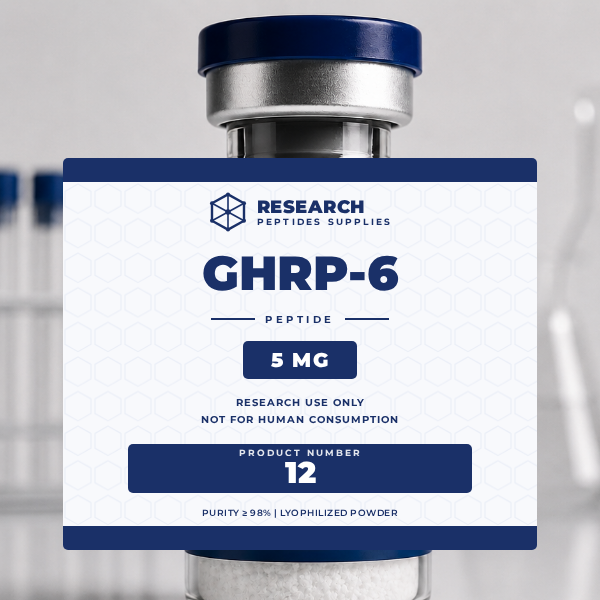
GHRP-6 Research Peptide — Scientific Overview
GHRP-6 (Growth Hormone Releasing Peptide 6; His-D-Trp-Ala-Trp-D-Phe-Lys-NH₂) is a synthetic hexapeptide and one of the first-generation growth hormone releasing peptides characterized by Cyril Bowers and colleagues. GHRP-6 was identified through systematic modifications of enkephalin analogs in the search for peptides capable of stimulating GH release through mechanisms independent of GHRH. Its discovery was pivotal in establishing the existence of a distinct GH secretagogue receptor pathway that was later identified as the ghrelin receptor (GHS-R1a).
GHRP-6 represents a historically important research compound — its study in the 1980s and 1990s contributed to the eventual discovery of ghrelin itself in 1999 (Kojima et al., Nature). GHRP-6’s GH-stimulatory effects were known for over 15 years before the endogenous ligand (ghrelin) was identified, making GHRP-6 a key pharmacological tool in the sequence of discoveries that uncovered the ghrelin axis. GHRP-6 also notably stimulates appetite in research models — an effect attributed to its ghrelin receptor agonism in hypothalamic appetite-regulatory centers.
Research Background
Research with GHRP-6 spans GH secretagogue pharmacology, appetite and feeding behavior studies, ghrelin receptor biology, cardiac research (cardioprotection in ischemia models), and neuroprotection studies. It remains a valuable reference compound for ghrelin receptor pharmacology research and for historical comparison with newer, more selective GHRPs.
Key Research Areas
- GH Secretagogue Research: First-generation GHRP pharmacology and GH release studies
- Ghrelin Receptor Research: GHS-R1a biology and the historical context of ghrelin discovery
- Appetite Research: Appetite stimulation and feeding behavior studies via hypothalamic GHS-R1a
- Cardiac Research: Cardioprotective effects in ischemia/reperfusion models
- Neuroprotection Research: Neural protection studies in preclinical models
- Comparative Pharmacology: Reference GHRP for comparing selectivity profiles of newer GHRPs
Technical Specifications
| Parameter |
Value |
| Sequence |
His-D-Trp-Ala-Trp-D-Phe-Lys-NH₂ |
| Molecular Weight |
873.0 Da |
| Purity |
≥98% (HPLC-verified) |
| Form |
Lyophilized powder, sealed under argon |
| Storage |
−20°C (long-term) |
| Documentation |
Batch-specific COA (HPLC + Mass Spec) |
Storage & Handling (Research Laboratories)
Lyophilized GHRP-6 should be stored at −20°C for long-term preservation, protected from light and moisture. For short-term active research use, 4°C storage is acceptable for up to approximately 4 weeks. Minimize repeated freeze-thaw cycles. Follow standard laboratory peptide reconstitution and handling protocols for all experimental use.
Frequently Asked Questions — GHRP-6 Research
What is the historical significance of GHRP-6 in GH research?
GHRP-6 is one of the first compounds in the GHRP class, characterized by Cyril Bowers and colleagues in the early 1980s. Its discovery demonstrated that GH release could be stimulated through a pathway entirely distinct from GHRH — using enkephalin-derived peptides acting on what was then an unknown receptor. The 15+ years of research into GHRP-6 and related compounds ultimately led to the discovery of ghrelin in 1999 — the endogenous hormone that naturally activates the same receptor. GHRP-6 is thus historically linked to one of the major discoveries in endocrinology of the late 20th century.
Why does GHRP-6 stimulate appetite in research models?
GHRP-6 is an agonist at the ghrelin receptor (GHS-R1a), which is expressed not only on pituitary somatotrophs but also in the hypothalamic arcuate nucleus — the brain region that controls appetite. Ghrelin itself is the primary appetite-stimulating hormone (‘hunger hormone’), and GHRP-6’s stimulation of hypothalamic GHS-R1a mimics ghrelin’s orexigenic (appetite-increasing) effects. In animal studies, GHRP-6 administration produces dose-dependent increases in food intake. This appetite-stimulating property distinguishes GHRP-6 from more selective GHRPs like Ipamorelin and makes it particularly relevant for appetite biology research.
What cardiac research has been conducted with GHRP-6?
Multiple preclinical studies have examined GHRP-6’s effects on cardiac biology. Research published in journals including the American Journal of Physiology and the European Journal of Pharmacology has documented that GHRP-6 reduces infarct size and improves contractile function recovery in rodent ischemia-reperfusion models. These cardioprotective effects appear to involve GHS-R1a activation, AMPK pathway stimulation, and mitochondrial protective mechanisms independent of the GH-stimulatory effects. These are preclinical findings and do not indicate clinical cardiac use.
Is GHRP-6 approved for human use?
No. GHRP-6 is not FDA-approved for any human therapeutic application. Research Peptides Supplies supplies it for qualified laboratory research use only.
What documentation comes with GHRP-6?
GHRP-6 from Research Peptides Supplies is verified at ≥98% purity by HPLC with identity confirmed by Mass Spectrometry. A batch-specific COA is provided with every order.
⚗️ Research Use Only: This product is strictly intended for qualified laboratory and scientific research use by trained professionals in appropriate laboratory settings. It is not intended for human or veterinary administration, therapeutic use, food supplement applications, or any use outside controlled research environments. Not for human consumption.