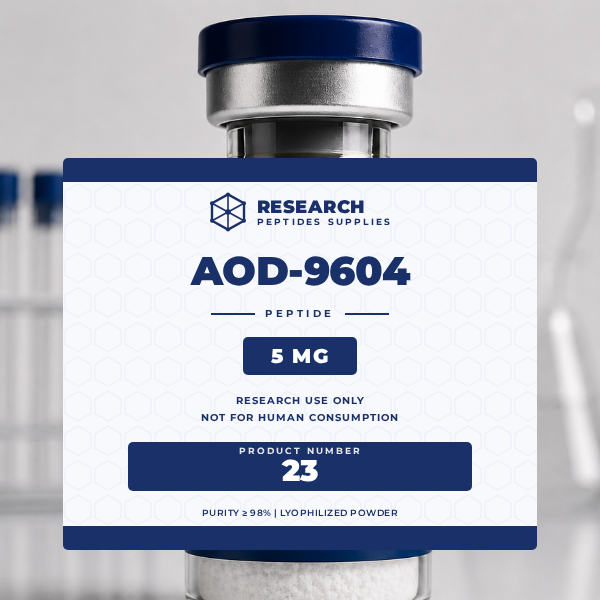
AOD-9604 Research Peptide — Scientific Overview
AOD-9604 (Anti-Obesity Drug 9604) is a synthetic peptide corresponding to amino acids 176-191 of the human growth hormone (hGH) sequence, modified with an additional tyrosine at the N-terminus. This 16-residue fragment encompasses the C-terminal region of hGH that has been associated with the hormone’s lipolytic (fat-mobilizing) activity in preclinical and clinical research. AOD-9604 was developed by Monash University researchers and licensed to Metabolic Pharmaceuticals Pty Ltd (Australia) for pharmaceutical development.
The strategic interest in AOD-9604 lies in the observation that different domains of growth hormone are responsible for different biological activities. The N-terminal portions of GH drive growth-promoting effects (mediated through GH receptor activation and IGF-1 induction), while the C-terminal 176-191 region has been associated with lipolytic activity with minimal GH receptor engagement. By isolating this fragment, researchers can study GH’s fat-mobilizing mechanisms without the growth-promoting, insulin-desensitizing, or other IGF-1-dependent effects of full hGH.
Research Background
AOD-9604 has been studied in Phase I, II, and III clinical trials. Phase III trials for obesity management conducted in Australia reported statistically significant reductions in body fat at certain doses, though the drug was ultimately not approved for obesity treatment. A 2007 publication by Heffernan et al. (Endocrinology) characterized AOD-9604’s mechanisms in vitro and in animal models. Notably, AOD-9604 received a GRAS (Generally Recognized As Safe) classification from the FDA for food use in 2014, which has generated some research interest.
Key Research Areas
- Lipolysis Research: Fat cell (adipocyte) lipolytic mechanism studies and triglyceride mobilization
- Metabolic Research: Adipose tissue biology and lipid metabolism pathway investigations
- GH Domain Research: Structure-activity relationship studies of GH fragment bioactivity
- Obesity Research: Body composition and visceral fat research in preclinical and clinical models
- Cartilage Research: Articular cartilage regeneration studies (distinct from metabolic research)
- Comparative Research: GH fragment vs. full hGH mechanism comparison studies
Technical Specifications
| Parameter | Value |
|---|---|
| Sequence | Tyr-hGH(176-191) — modified C-terminal GH fragment |
| Molecular Weight | ~1817 Da |
| Purity | ≥98% (HPLC-verified) |
| Form | Lyophilized powder, sealed under argon |
| Storage | −20°C (long-term) |
| Documentation | Batch-specific COA (HPLC + Mass Spec) |
Storage & Handling (Research Laboratories)
Lyophilized AOD-9604 should be stored at −20°C for long-term preservation, protected from light and moisture. For short-term active research use, 4°C storage is acceptable for up to approximately 4 weeks. Minimize repeated freeze-thaw cycles. Follow standard laboratory peptide reconstitution and handling protocols for all experimental use.