⌕♙🛒
,

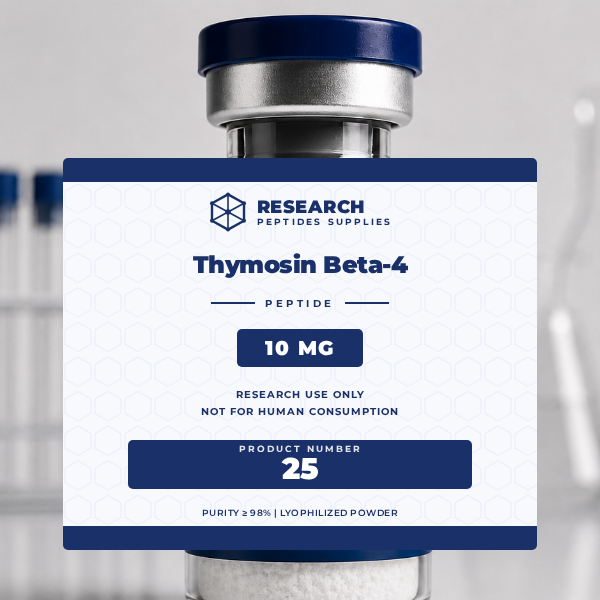
Thymosin Beta-4

$44.99

Thymosin Beta-4 (TB4) — full-length synthetic Thymosin Beta-4 — the naturally occurring 43-amino-acid protein abundant in platelets, wound fluid, and virtually all mammalian cells. The endogenous actin-sequestering protein studied for tissue repair, cardiac biology, angiogenesis, and anti-inflammatory research. Supplied lyophilized at ≥98% purity (HPLC-verified) with batch-specific COA. For research use only.

Thymosin Beta-4 (TB4) Research Peptide — Scientific Overview

Thymosin Beta-4 (Tβ4) is a naturally occurring 43-amino-acid protein first isolated from calf thymus tissue by Low and Goldstein in 1981. It is one of the most abundant intracellular peptides in mammalian cells (particularly platelets and macrophages), present at micromolar concentrations in the cytoplasm and extracellular fluids. Unlike many research peptides, Thymosin Beta-4 is a well-characterized endogenous protein with established physiological roles — most prominently as the major G-actin sequestering protein that regulates the cellular pool of unpolymerized actin available for cytoskeletal dynamics.

Tβ4’s primary molecular function is to sequester G-actin (monomeric actin) in a 1:1 complex, thereby regulating the dynamic balance between G-actin and F-actin (filamentous actin). This regulation of actin polymerization influences virtually every actin-dependent cellular process including cell motility, shape, division, and phagocytosis. In addition to its cytoskeletal role, Tβ4 contains an active domain (LKKTET) that mediates many of its extracellular activities including promotion of angiogenesis, wound healing, and cardiac progenitor cell activation.

Research Background

The biomedical research profile of Thymosin Beta-4 has expanded dramatically since the early 2000s when its extracellular and secreted forms were recognized as potent modulators of tissue repair and angiogenesis. Regeneration Technologies (RegeneRx) has conducted clinical trials with recombinant Tβ4 in wound healing, dry eye syndrome, and cardiac protection, providing a substantial human safety and pharmacokinetic database that supports its research use.

Key Research Areas

  • Actin Biology Research: G-actin sequestration, cytoskeletal dynamics, and actin polymerization studies
  • Wound Healing Research: Tissue repair pathway studies and wound closure biology
  • Cardiac Research: Cardiac progenitor cell activation and post-infarction repair studies
  • Angiogenesis Research: Vascular endothelial cell migration and new vessel formation studies
  • Anti-Inflammatory Research: NF-κB pathway modulation and inflammatory mediator studies
  • Neurological Research: Neuroprotective effects and neural repair pathway biology

Technical Specifications

Parameter Value
Sequence 43 amino acids (Ser-Asp-Lys-Pro-Asp-Met-Ala-Glu-Ile-Glu-Lys-Phe-Asp-Lys-Ser-Lys-Leu-Lys-Lys-Thr-Glu-Thr-Gln-Glu-Lys-Asn-Pro-Leu-Pro-Ser-Lys-Glu-Thr-Ile-Glu-Gln-Glu-Lys-Gln-Ala-Gly-Glu-Ser)
Molecular Weight 4963.5 Da
Purity ≥98% (HPLC-verified)
Form Lyophilized powder, sealed under argon
Storage −20°C (long-term)
Documentation Batch-specific COA (HPLC + Mass Spec)

Storage & Handling (Research Laboratories)

Lyophilized Thymosin Beta-4 (TB4) should be stored at −20°C for long-term preservation, protected from light and moisture. For short-term active research use, 4°C storage is acceptable for up to approximately 4 weeks. Minimize repeated freeze-thaw cycles. Follow standard laboratory peptide reconstitution and handling protocols for all experimental use.
Frequently Asked Questions — Thymosin Beta-4 (TB4) Research

What is the difference between Thymosin Beta-4 and TB-500?
Thymosin Beta-4 (Tβ4) is the full-length 43-amino-acid naturally occurring protein. TB-500 refers to a synthetic fragment or analog corresponding to a portion of Tβ4 — primarily the biologically active actin-binding sequence LKKTET and surrounding residues. Researchers studying the complete protein including all its structural domains (actin-binding, NLS sequences, and full C-terminal domain) use full-length Tβ4. TB-500 analogs are used when studying the specific activities of the LKKTET active domain in isolation. Both share the core LKKTET sequence but differ in the flanking sequences and overall structural context.
How does Thymosin Beta-4 regulate actin polymerization?
Thymosin Beta-4 sequesters G-actin (monomeric actin) through direct 1:1 binding with a Kd of approximately 0.5–1 μM. This sequestration controls the ‘critical concentration’ — the concentration of free G-actin available for new filament nucleation and elongation. In resting cells, approximately 50% of total actin is sequestered by Tβ4 as a G-actin:Tβ4 complex. When cells need to rapidly reorganize their cytoskeleton (during migration, division, or in response to signaling), Tβ4-bound actin can be released by competing binding proteins like profilin, providing the monomer pool needed for rapid F-actin assembly.
What cardiac research has been conducted with Thymosin Beta-4?
RegeneRx’s CHAMP and COCQ clinical studies examined recombinant Tβ4 (RGN-352) in patients with acute myocardial infarction and stable ischemic cardiomyopathy respectively. Preclinical research by Eduardo Marban and colleagues, and separately by Dr. Nadia Smart’s group at Oxford, documented that Tβ4 activates cardiac progenitor cells called epicardium-derived cells (EPDCs), facilitating their differentiation and migration into the infarcted myocardium. These EPDC-activating properties distinguish Tβ4 from other reparative peptides and make it particularly relevant for cardiac regeneration research.
Is Thymosin Beta-4 approved for human use?
No. Recombinant Tβ4 (RGN-352) has been tested in human clinical trials by RegeneRx but has not received FDA approval for any indication. Research Peptides Supplies supplies Thymosin Beta-4 for qualified laboratory research use only.
What documentation comes with Thymosin Beta-4?
Thymosin Beta-4 from Research Peptides Supplies is verified at ≥98% purity by HPLC with identity confirmed by Mass Spectrometry. A batch-specific COA is provided with every order.
⚗️ Research Use Only: This product is strictly intended for qualified laboratory and scientific research use by trained professionals in appropriate laboratory settings. It is not intended for human or veterinary administration, therapeutic use, food supplement applications, or any use outside controlled research environments. Not for human consumption.
Shopping Cart
Scroll to Top