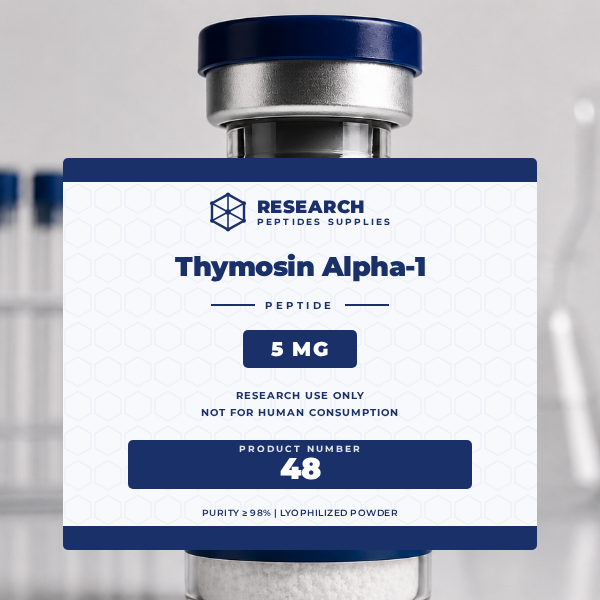
Thymosin Alpha-1 Research Peptide — Scientific Overview
Thymosin Alpha-1 (Tα1) is a 28-amino-acid peptide naturally produced by thymic epithelial cells as the N-terminal fragment of prothymosin alpha. It is the most biologically characterized member of the thymosin family and was the first thymic peptide to be fully characterized, synthesized, and advanced to clinical approval. Thymosin Alpha-1 (synthesized as thymalfasin; brand name Zadaxin®) has received regulatory approval in over 35 countries for augmenting immune responses in chronic hepatitis B and C, immunocompromised states, and certain cancers.
Thymosin Alpha-1 (Tα1) is a 28-amino-acid peptide naturally produced by thymic epithelial cells as the N-terminal fragment of prothymosin alpha. It is the most biologically characterized member of the thymosin family and was the first thymic peptide to be fully characterized, synthesized, and advanced to clinical approval. Thymosin Alpha-1 (synthesized as thymalfasin; brand name Zadaxin®) has received regulatory approval in over 35 countries for augmenting immune responses in chronic hepatitis B and C, immunocompromised states, and certain cancers. Thymosin Alpha-1 activates Toll-like receptor (TLR) 9 signaling in dendritic cells, drives dendritic cell maturation and antigen presentation, promotes Th1 T-helper cell differentiation (pro-cellular immunity), activates natural killer (NK) cells, and enhances cytotoxic T-lymphocyte (CTL) responses. It has been studied in >4,000 patients across clinical trials for hepatitis, cancer (as an adjunct to chemotherapy/radiation), and more recently in COVID-19 critical illness and sepsis-induced immunosuppression.
Research Background
Thymosin Alpha-1 activates Toll-like receptor (TLR) 9 signaling in dendritic cells, drives dendritic cell maturation and antigen presentation, promotes Th1 T-helper cell differentiation (pro-cellular immunity), activates natural killer (NK) cells, and enhances cytotoxic T-lymphocyte (CTL) responses. It has been studied in >4,000 patients across clinical trials for hepatitis, cancer (as an adjunct to chemotherapy/radiation), and more recently in COVID-19 critical illness and sepsis-induced immunosuppression.
Key Research Areas
- Immune Activation Research: Dendritic cell maturation, antigen presentation, and T-cell activation
- Cancer Immunology Research: CTL activation, NK cell enhancement, and tumor immune surveillance
- Viral Immunity Research: Antiviral T-cell responses, IFN-γ production, and chronic viral infection models
- Sepsis Research: Sepsis-induced immunosuppression reversal and innate immune restoration
- Vaccine Adjuvant Research: Thymosin alpha-1 as an immunological adjuvant for antigen response enhancement
- T-Cell Biology Research: Thymic maturation, Th1/Th2 balance, and regulatory T-cell studies
Technical Specifications
| Parameter | Value |
|---|---|
| Sequence | Ac-Ser-Asp-Ala-Ala-Val-Asp-Thr-Ser-Ser-Glu-Ile-Thr-Thr-Lys-Asp-Leu-Lys-Glu-Lys-Lys-Glu-Val-Val-Glu-Glu-Ala-Glu-Asn (28 AA) |
| Molecular Weight | 3108 Da |
| Purity | ≥99% (HPLC-verified) |
| Form | Lyophilized powder, sealed under argon |
| Storage | −20°C (long-term) |
| Documentation | Batch-specific COA (HPLC + Mass Spec) |
Storage & Handling (Research Laboratories)
Lyophilized Thymosin Alpha-1 should be stored at −20°C for long-term preservation, protected from light and moisture. For short-term active research use, 4°C storage is acceptable for up to approximately 4 weeks. Minimize repeated freeze-thaw cycles. Follow standard laboratory peptide reconstitution and handling protocols for all experimental use.