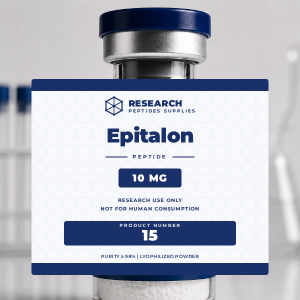
Thymalin Research Peptide — Scientific Overview
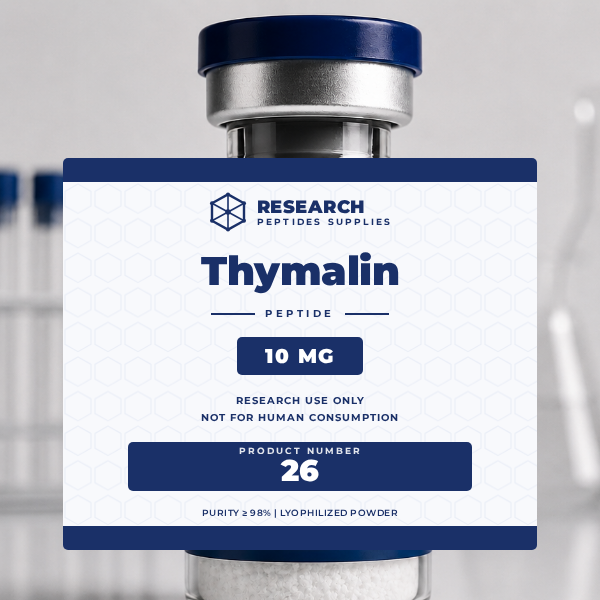
Thymalin is a natural peptide preparation derived from the thymus gland, developed as part of the systematic peptide bioregulator research program led by Professor Vladimir Khavinson at the St. Petersburg Institute of Bioregulation and Gerontology. As one of the original ‘cytomedines’ — tissue-specific bioregulators — Thymalin represents a defined-composition tetrapeptide based on the most biologically active sequences isolated from thymus extracts through bioguided fractionation research.
The thymus gland is responsible for T-cell maturation and immune system education, and undergoes progressive involution (age-related shrinkage) beginning in early adulthood. Thymic involution is closely associated with immunosenescence — the age-related deterioration of immune function — making thymic peptide biology an important area of research for aging and immune decline. Thymalin and related thymic bioregulators are studied as tools for investigating thymus biology, T-cell regulation, and potential approaches to slowing immunosenescence.
Research Background
Published Thymalin research from the St. Petersburg Institute of Bioregulation and Gerontology includes animal longevity studies demonstrating extended median and maximal lifespan in treated rodents, immunological studies examining T-cell subset normalization in aging models, and clinical research conducted in Russia examining immune parameters in elderly subjects. The research spans gerontological immunology, longevity biology, and oncological immune recovery studies.
Key Research Areas
- Immunological Research: T-cell biology, thymic function, and immune system regulation studies
- Aging Research: Immunosenescence and age-related immune decline investigation
- Thymic Biology Research: Thymus involution, thymic output, and thymocyte development studies
- Longevity Research: Lifespan modulation and healthspan studies in animal models
- Oncology Support Research: Immune recovery following chemotherapy in preclinical models
- Peptide Bioregulator Research: Tissue-specific bioregulator mechanisms and cytomedine biology
Technical Specifications
| Parameter |
Value |
| Classification |
Thymic tetrapeptide bioregulator |
| Purity |
≥98% (HPLC-verified) |
| Form |
Lyophilized powder, sealed under argon |
| Storage |
−20°C (long-term) |
| Documentation |
Batch-specific COA (HPLC + Mass Spec) |
Storage & Handling (Research Laboratories)
Lyophilized Thymalin should be stored at −20°C for long-term preservation, protected from light and moisture. For short-term active research use, 4°C storage is acceptable for up to approximately 4 weeks. Minimize repeated freeze-thaw cycles. Follow standard laboratory peptide reconstitution and handling protocols for all experimental use.
Frequently Asked Questions — Thymalin Research
What are peptide bioregulators and how does Thymalin fit within this class?
Peptide bioregulators, also called cytomedines, are a class of short natural peptides (typically 2-4 amino acids) isolated from specific organ tissues that exert tissue-specific regulatory effects. They were systematically developed by Professor Khavinson’s group at the St. Petersburg Institute through a process of bioguided fractionation — isolating the most biologically active peptide fractions from organ extracts, then identifying the minimal active sequences. Thymalin was derived from thymus tissue using this approach and represents the thymic branch of this bioregulator series, alongside other organ-specific bioregulators like Epithalamin (pineal gland) and Cortexin (cortex tissue).
What immune effects has Thymalin shown in preclinical research?
Research into Thymalin has examined effects on multiple immune parameters in aging animal models. Studies have reported normalization of T-cell subset ratios (CD4/CD8 balance), restoration of T-cell proliferative response to mitogenic stimulation, improvement of natural killer (NK) cell activity, and modulation of pro-inflammatory cytokine production. In oncological research models, Thymalin has been studied for its ability to facilitate immune recovery following immunosuppressive treatments.
What longevity research has been conducted with Thymalin?
Animal longevity studies published by the St. Petersburg Institute of Bioregulation demonstrated extended median and maximal lifespan in aged mice and rats treated with Thymalin compared to controls. These studies, conducted in the 1980s-2000s, found that mice receiving regular Thymalin administration showed reduced incidence of age-related pathologies including neoplasias, metabolic disorders, and cardiovascular abnormalities alongside the lifespan extension. These findings are from animal models and do not constitute evidence of lifespan extension in humans.
Is Thymalin available as a pharmaceutical?
Thymalin (as a standardized thymus extract preparation) is registered as a pharmaceutical in Russia for clinical immune-related applications. However, it is not FDA-approved for use in the United States. Research Peptides Supplies supplies Thymalin for qualified laboratory research use only and not for human administration.
What documentation is provided with Thymalin?
Thymalin from Research Peptides Supplies is verified at ≥98% purity by HPLC with identity confirmed by Mass Spectrometry. A batch-specific COA documenting lot number, purity results, mass data, and testing methodology is provided with each order.
⚗️ Research Use Only: This product is strictly intended for qualified laboratory and scientific research use by trained professionals in appropriate laboratory settings. It is not intended for human or veterinary administration, therapeutic use, food supplement applications, or any use outside controlled research environments. Not for human consumption.