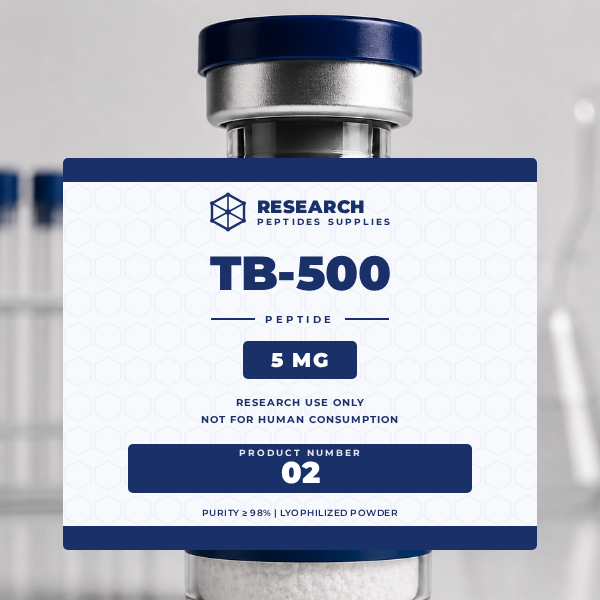
TB-500 Research Peptide — Scientific Overview
TB-500 is a synthetic peptide analog derived from the active region of Thymosin Beta-4 (Tβ4), a 43-amino-acid protein found in high concentrations in platelets, wound fluid, and virtually all mammalian cell types. The biologically active fragment studied under the TB-500 designation centers on the actin-binding domain of Tβ4 and is frequently used in preclinical research investigating tissue biology, cellular migration, and vascular formation processes.
Thymosin Beta-4 was first isolated from thymic tissue and is one of the most abundant and ubiquitous intracellular peptides in eukaryotic cells. Research into synthetic analogs like TB-500 aims to study the specific molecular interactions responsible for Tβ4’s observed biological activities in controlled laboratory environments. TB-500 is water-soluble and demonstrates good stability under standard research storage conditions.
Research Background
Scientific research into Thymosin Beta-4 and its analogs spans several decades, with studies published in journals covering immunology, cardiology, ophthalmology, neuroscience, and wound biology. The primary mechanism investigated involves the peptide’s role in regulating actin polymerization — a fundamental process in cell motility, shape, and division. Research has also examined interactions with angiogenic pathways, particularly studies involving vascular endothelial cell behavior and the formation of new blood vessel structures in preclinical animal models.
Key Research Areas
- Actin Biology: G-actin sequestration and regulation of actin polymerization dynamics
- Vascular Research: Endothelial cell migration and angiogenic pathway studies
- Cardiac Research: Myocardial tissue biology investigations in preclinical models
- Tissue Repair Biology: Cellular migration and tissue remodeling in wound models
- Anti-Inflammatory Pathway Research: Modulation of pro-inflammatory mediators in laboratory settings
- Neurological Research: Neuroprotective pathway studies in CNS models
Technical Specifications
| Parameter |
Value |
| Peptide Name |
Thymosin Beta-4 Fragment / TB-500 |
| Molecular Formula |
C212H350N56O78S |
| Molecular Weight |
4963.5 Da |
| Purity |
≥98% (HPLC-verified) |
| Form |
Lyophilized powder, sealed under argon |
| Storage |
−20°C (long-term); 4°C (short-term) |
| Documentation |
Batch-specific COA (HPLC + Mass Spec) |
Storage & Handling (Research Laboratories)
TB-500 lyophilized peptide should be stored at −20°C in a sealed, light-protected container. For active research use, short-term storage at 4°C (up to approximately 4 weeks) is acceptable. Reconstitution for research experiments should follow the specific protocol used in the laboratory. Minimize exposure to UV light and moisture. Avoid repeated freeze-thaw cycles which can degrade peptide structure and reduce experimental reproducibility.
Frequently Asked Questions — TB-500 Research
What is the relationship between TB-500 and Thymosin Beta-4?
TB-500 is a synthetic fragment or analog derived from Thymosin Beta-4 (Tβ4), a naturally occurring 43-amino-acid protein found in nearly all mammalian cells. Research into TB-500 focuses on the biologically active portion of Tβ4, particularly the actin-binding domain (LKKTET sequence). Synthetic analogs like TB-500 allow researchers to study specific molecular activities in isolation and in controlled experimental conditions without the complexity of working with full-length endogenous proteins.
What biological pathways does TB-500 interact with in research models?
Preclinical research into TB-500 and Thymosin Beta-4 has examined several biological pathways. The most studied is actin polymerization regulation — the peptide sequesters G-actin, influencing cell motility, shape, and migration. Research has also investigated angiogenic pathway interactions (particularly VEGF and endothelial cell behavior), anti-inflammatory signaling (NF-κB pathway modulation in some models), and tissue remodeling biology. These interactions are studied in in vitro cell models and animal models under controlled laboratory conditions.
What purity and documentation does Research Peptides Supplies provide for TB-500?
TB-500 from Research Peptides Supplies is independently verified at ≥98% purity using HPLC analysis. Molecular identity is confirmed via Mass Spectrometry. Each batch receives a unique lot number, and a batch-specific Certificate of Analysis (COA) documenting HPLC results, mass verification, testing methodology, and lot traceability is available for all orders.
How is TB-500 different from full-length Thymosin Beta-4?
Full-length Thymosin Beta-4 is a 43-amino-acid protein, while TB-500 refers to a synthetic analog focused on the active fragment sequence. In research, synthetic analogs offer advantages in terms of production consistency, solubility, and the ability to study specific receptor interactions or molecular activities in isolation. Researchers studying Tβ4 biology often use both the full-length protein and active fragments to understand structure-activity relationships.
Is TB-500 approved for human use or clinical application?
No. TB-500 is not FDA-approved or cleared for human therapeutic, clinical, or supplemental use. It is supplied exclusively for qualified laboratory research use by trained scientific professionals in controlled research environments. It should not be administered to humans or animals, and it is not a food supplement or pharmaceutical product.
⚗️ Research Use Only: This product is strictly intended for qualified laboratory and scientific research use by trained professionals in appropriate laboratory settings. It is not intended for human or veterinary administration, therapeutic use, food supplement applications, or any use outside controlled research environments. Not for human consumption.