
⌕♙🛒

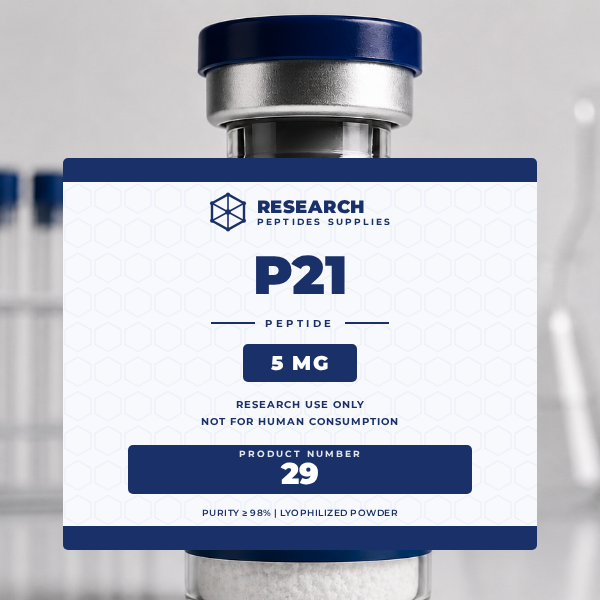
P21

$49.99

P21 — a CNTF-derived peptide (a 24-amino-acid segment derived from ciliary neurotrophic factor) studied for neurogenesis, hippocampal biology, and STAT3 pathway modulation in preclinical models. Supplied lyophilized at ≥98% purity (HPLC-verified) with batch-specific COA. For research use only.

SKU: RPS-P21-001 Category: Tags: ,

P21 Research Peptide — Scientific Overview

P21 is a 24-amino-acid synthetic peptide derived from the sequence of CNTF (Ciliary Neurotrophic Factor), a member of the IL-6 superfamily of cytokines that plays a critical role in neural development, survival, and differentiation. CNTF signals through a multi-subunit receptor complex (CNTF-Rα/gp130/LIF-Rβ), but P21 is reported to act through a distinct receptor mechanism — binding to CNTF-Rα without requiring the full receptor complex — which may give it a more targeted neurological activity profile than full-length CNTF.

Research into P21 has been driven by interest in its potential role in hippocampal neurogenesis — the process by which new neurons are generated in the adult brain’s dentate gyrus. Studies in rodent models have examined P21’s ability to promote neural precursor cell proliferation and neuronal differentiation in the hippocampus, with potential relevance to research on memory formation, depression biology, and neurodegenerative disease models.

Research Background

Published preclinical research on P21 has examined its neurogenesis-promoting effects in hippocampal progenitor cell assays and in vivo rodent models. Studies have investigated STAT3 (Signal Transducer and Activator of Transcription 3) pathway activation as the key downstream signaling mechanism. STAT3 is a major downstream effector of CNTF signaling and plays important roles in neural stem cell proliferation, differentiation, and survival. P21 has been studied as a more targeted alternative to CNTF for neuroplasticity research because of CNTF’s complex receptor requirements and broader biological effects.

Key Research Areas

  • Neurogenesis Research: Hippocampal neural precursor cell proliferation and differentiation studies
  • STAT3 Pathway Research: Signal transducer pathway activation in neural cell models
  • CNTF Biology Research: CNTF receptor interaction and downstream signaling investigation
  • Memory Research: Hippocampal biology and spatial learning studies in rodent models
  • Neuroprotection Research: Neural survival and protection pathway studies
  • Depression Model Research: Neurogenesis modulation in behavioral depression models

Technical Specifications

Parameter Value
Classification CNTF-derived 24-amino-acid synthetic peptide
Molecular Weight ~2600 Da
Purity ≥98% (HPLC-verified)
Form Lyophilized powder, sealed under argon
Storage −20°C (long-term)
Documentation Batch-specific COA (HPLC + Mass Spec)

Storage & Handling (Research Laboratories)

Lyophilized P21 should be stored at −20°C for long-term preservation, protected from light and moisture. For short-term active research use, 4°C storage is acceptable for up to approximately 4 weeks. Minimize repeated freeze-thaw cycles. Follow standard laboratory peptide reconstitution and handling protocols for all experimental use.


Frequently Asked Questions — P21 Research

What is the relationship between P21 and CNTF?
P21 is a 24-amino-acid fragment derived from the sequence of CNTF (Ciliary Neurotrophic Factor). Full-length CNTF is a cytokine that signals through a trimeric receptor complex (CNTF-Rα, gp130, LIF-Rβ). P21 is proposed to bind only to CNTF-Rα without requiring the full receptor complex, potentially giving it a more limited and specific signaling profile than full CNTF. This specificity makes P21 useful as a research tool to investigate CNTF-Rα-specific signaling in isolation from full CNTF receptor complex activity.
What hippocampal research has been conducted with P21?
Research studies have investigated P21’s ability to promote neurogenesis in the adult hippocampal dentate gyrus — a region that continues to generate new neurons throughout adulthood in rodents and to a lesser extent in humans. Studies have examined P21’s effects on neural progenitor cell BrdU incorporation (a marker of cell proliferation), NeuN expression (a marker of neuronal differentiation), and behavioral outcomes on hippocampal-dependent memory tasks. P21 has been reported to enhance hippocampal neurogenesis and improve performance on spatial memory tasks in rodent models.
How does STAT3 relate to P21’s mechanism?
STAT3 (Signal Transducer and Activator of Transcription 3) is a key intracellular signaling molecule activated downstream of the CNTF receptor complex. STAT3 phosphorylation and nuclear translocation regulates expression of genes involved in neural stem cell maintenance, proliferation, and differentiation. P21 activates STAT3 signaling through CNTF-Rα binding, which is studied as the primary mechanism underlying its neurogenesis-promoting effects. STAT3 is also relevant to oncology research, inflammation biology, and immune cell function, expanding potential research applications of P21.
Is P21 available for human clinical use?
No. P21 is not approved for human therapeutic or clinical use by any regulatory authority. It is an investigational research compound supplied strictly for qualified laboratory research use by trained professionals in appropriate settings.
What purity documentation comes with P21?
P21 from Research Peptides Supplies is verified at ≥98% purity by HPLC with identity confirmed by Mass Spectrometry. A batch-specific COA documenting lot number, purity result, mass data, and testing methodology is included with every order.
⚗️ Research Use Only: This product is strictly intended for qualified laboratory and scientific research use by trained professionals in appropriate laboratory settings. It is not intended for human or veterinary administration, therapeutic use, food supplement applications, or any use outside controlled research environments. Not for human consumption.
Shopping Cart
Scroll to Top