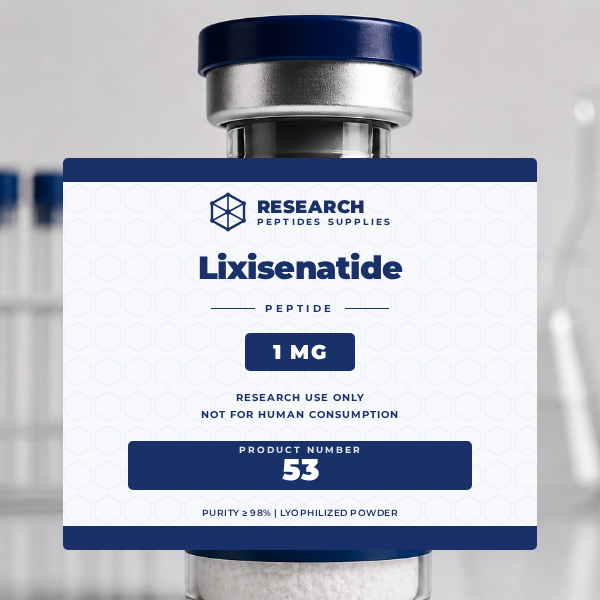
Lixisenatide Research Peptide — Scientific Overview
Lixisenatide is a synthetic 44-amino-acid GLP-1 receptor agonist derived from exendin-4 (like exenatide), modified by deletion of one proline and addition of 6 lysines at the C-terminus. These C-terminal lysines improve affinity for the GLP-1 receptor. Lixisenatide (Adlyxin®, developed by Sanofi) received FDA approval in 2016 for Type 2 diabetes. It is characterized as a short-acting GLP-1 agonist (once-daily administration) with particularly potent effects on post-prandial glucose excursions and gastric emptying.
Lixisenatide is a synthetic 44-amino-acid GLP-1 receptor agonist derived from exendin-4 (like exenatide), modified by deletion of one proline and addition of 6 lysines at the C-terminus. These C-terminal lysines improve affinity for the GLP-1 receptor. Lixisenatide (Adlyxin®, developed by Sanofi) received FDA approval in 2016 for Type 2 diabetes. It is characterized as a short-acting GLP-1 agonist (once-daily administration) with particularly potent effects on post-prandial glucose excursions and gastric emptying. Lixisenatide’s strong gastric emptying inhibition makes it distinctive among GLP-1 receptor agonists — it significantly delays gastric emptying, which blunts the rate of carbohydrate absorption and reduces post-prandial glucose excursions. This mechanism is particularly studied in the context of combination with basal insulin therapy (iGlarLixi) and in research models examining gastric motility biology and the interplay between GI physiology and glycemic regulation. The ELIXA cardiovascular outcomes trial (n=6,068) showed neutral CV effects — neither benefit nor harm.
Research Background
Lixisenatide’s strong gastric emptying inhibition makes it distinctive among GLP-1 receptor agonists — it significantly delays gastric emptying, which blunts the rate of carbohydrate absorption and reduces post-prandial glucose excursions. This mechanism is particularly studied in the context of combination with basal insulin therapy (iGlarLixi) and in research models examining gastric motility biology and the interplay between GI physiology and glycemic regulation. The ELIXA cardiovascular outcomes trial (n=6,068) showed neutral CV effects — neither benefit nor harm.
Key Research Areas
- Post-Prandial Glucose Research: Gastric emptying inhibition and meal-related glucose excursion studies
- GLP-1R Pharmacology Research: Short-acting GLP-1R agonism and receptor internalization kinetics
- Gastric Motility Research: Gastric emptying rate modulation and GI physiology studies
- Combination Therapy Research: Basal insulin + GLP-1 agonist combination effects in metabolic models
- β-Cell Research: Glucose-dependent insulin secretion and β-cell protection biology
- Comparative Pharmacology: Short-acting vs. long-acting GLP-1 agonist mechanism comparison
Technical Specifications
| Parameter | Value |
|---|---|
| Sequence | Exendin-4-derived, 44 AA with 6 C-terminal lysines |
| Molecular Weight | ~4858 Da |
| Purity | ≥98% (HPLC-verified) |
| Form | Lyophilized powder, sealed under argon |
| Storage | −20°C (long-term) |
| Documentation | Batch-specific COA (HPLC + Mass Spec) |
Storage & Handling (Research Laboratories)
Lyophilized Lixisenatide should be stored at −20°C for long-term preservation, protected from light and moisture. For short-term active research use, 4°C storage is acceptable for up to approximately 4 weeks. Minimize repeated freeze-thaw cycles. Follow standard laboratory peptide reconstitution and handling protocols for all experimental use.