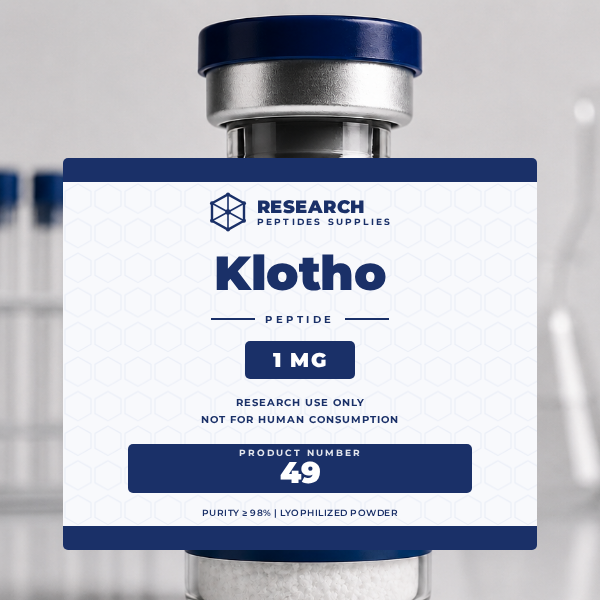
Klotho Research Peptide — Scientific Overview
α-Klotho is a single-pass transmembrane protein and co-receptor for Fibroblast Growth Factor 23 (FGF23) that is highly expressed in kidney tubular cells and choroid plexus. A soluble form of α-Klotho (sKlotho) circulates in blood and exerts pleiotropic beneficial effects — cognitive protection, kidney protection, anti-fibrotic activity, cardiovascular protection, and longevity association — that decline with aging. Research Peptides Supplies offers α-Klotho peptide fragment(s) for in vitro and in vivo research models investigating Klotho’s biological roles.
α-Klotho is a single-pass transmembrane protein and co-receptor for Fibroblast Growth Factor 23 (FGF23) that is highly expressed in kidney tubular cells and choroid plexus. A soluble form of α-Klotho (sKlotho) circulates in blood and exerts pleiotropic beneficial effects — cognitive protection, kidney protection, anti-fibrotic activity, cardiovascular protection, and longevity association — that decline with aging. Research Peptides Supplies offers α-Klotho peptide fragment(s) for in vitro and in vivo research models investigating Klotho’s biological roles. The Klotho protein was discovered by Kuro-o et al. (1997, Nature) when mice lacking the Klotho gene displayed accelerated aging phenotypes including osteoporosis, arteriosclerosis, pulmonary emphysema, skin atrophy, and cognitive decline. Conversely, mice overexpressing Klotho had extended lifespans. In humans, circulating Klotho levels decline with age and are associated with cognitive decline, kidney disease progression, cardiovascular mortality, and frailty — making it one of the most extensively studied longevity biomarkers and potential therapeutic targets.
Research Background
The Klotho protein was discovered by Kuro-o et al. (1997, Nature) when mice lacking the Klotho gene displayed accelerated aging phenotypes including osteoporosis, arteriosclerosis, pulmonary emphysema, skin atrophy, and cognitive decline. Conversely, mice overexpressing Klotho had extended lifespans. In humans, circulating Klotho levels decline with age and are associated with cognitive decline, kidney disease progression, cardiovascular mortality, and frailty — making it one of the most extensively studied longevity biomarkers and potential therapeutic targets.
Key Research Areas
- Longevity/Aging Research: Age-related phenotype modulation and lifespan extension in animal models
- Cognitive Aging Research: Age-related cognitive decline prevention and memory protection studies
- Kidney Research: Renal protection, CKD progression, and FGF23/Klotho axis studies
- Anti-Fibrosis Research: Organ fibrosis inhibition through TGF-β pathway modulation
- Cardiovascular Research: Arterial stiffness, endothelial protection, and cardiac aging studies
- FGF23 Axis Research: FGF23 co-receptor biology and mineral metabolism in kidney disease
Technical Specifications
| Parameter | Value |
|---|---|
| Classification | α-Klotho peptide fragment (recombinant fragment or synthetic KP1/KP2 peptide) |
| Target | FGF23/FGFR1 complex, TGF-β pathway, oxidative stress pathways |
| Purity | ≥98% (HPLC-verified) |
| Form | Lyophilized powder, sealed under argon |
| Storage | −20°C (long-term) |
| Documentation | Batch-specific COA (HPLC + Mass Spec) |
Storage & Handling (Research Laboratories)
Lyophilized Klotho should be stored at −20°C for long-term preservation, protected from light and moisture. For short-term active research use, 4°C storage is acceptable for up to approximately 4 weeks. Minimize repeated freeze-thaw cycles. Follow standard laboratory peptide reconstitution and handling protocols for all experimental use.