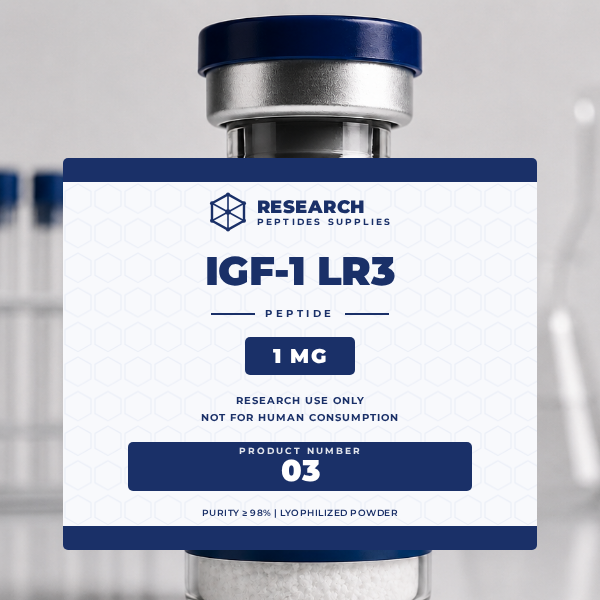
IGF-1 LR3 Research Peptide — Scientific Overview
IGF-1 LR3 (Long Arg3 IGF-1) is a modified recombinant analog of insulin-like growth factor 1 that incorporates two structural changes to reduce IGFBP binding: (1) an N-terminal 13-amino-acid extension (Met-Arg₁₂) that sterically inhibits IGFBP-3 binding, and (2) substitution of glutamic acid at position 3 with arginine (Glu3→Arg). These modifications reduce IGF-1 LR3’s affinity for IGF binding proteins by approximately 1000-fold compared to native IGF-1, while maintaining similar affinity for the IGF-1 receptor (IGF-1R).
The biological significance of IGFBP binding lies in the fact that greater than 99% of circulating native IGF-1 is bound to one of six IGF binding proteins (IGFBP-1 through IGFBP-6), primarily IGFBP-3. This binding dramatically limits the bioavailability of free (active) IGF-1. IGF-1 LR3 effectively bypasses this binding protein sequestration, making vastly more IGF-1R-active peptide available in research models. The result is an approximately 3-fold longer plasma half-life and dramatically enhanced mitogenic and anabolic potency per mole compared to native IGF-1 in cell culture and animal research.
Research Background
IGF-1 LR3 is widely used in cell biology research as the preferred IGF-1 isoform for cell culture studies — particularly for serum-free media where achieving physiological IGF-1 pathway activation is difficult with native IGF-1 due to IGFBP interference. In vivo animal research has used IGF-1 LR3 to study sustained IGF-1R signaling, muscle hypertrophy, and metabolic effects with reduced injection frequency compared to native IGF-1.
Key Research Areas
- Cell Culture Research: Serum-free media IGF-1 receptor activation and mitogenic studies
- Muscle Biology Research: Skeletal muscle hypertrophy and protein synthesis studies with prolonged IGF-1 signaling
- IGFBP Biology Research: Binding protein interference studies and free vs. bound IGF-1 bioavailability
- Metabolic Research: Insulin-sensitization, glucose metabolism, and mTOR pathway studies
- Cancer Biology Research: IGF-1R signaling in cancer proliferation and resistance models
- In Vitro Pharmacology: Reference IGF-1 analog for receptor binding and signaling studies
Technical Specifications
| Parameter | Value |
|---|---|
| Classification | IGF-1 analog; Glu3→Arg + N-terminal Met-Arg₁₂ extension |
| Molecular Weight | ~9.1 kDa |
| Purity | ≥97% (SDS-PAGE / RP-HPLC verified) |
| Form | Lyophilized, recombinant E. coli |
| Storage | −20°C (long-term); 4°C (short-term) |
| Documentation | Batch-specific COA (SDS-PAGE + activity data) |
Storage & Handling (Research Laboratories)
Lyophilized IGF-1 LR3 should be stored at −20°C for long-term preservation, protected from light and moisture. For short-term active research use, 4°C storage is acceptable for up to approximately 4 weeks. Minimize repeated freeze-thaw cycles. Follow standard laboratory peptide reconstitution and handling protocols for all experimental use.