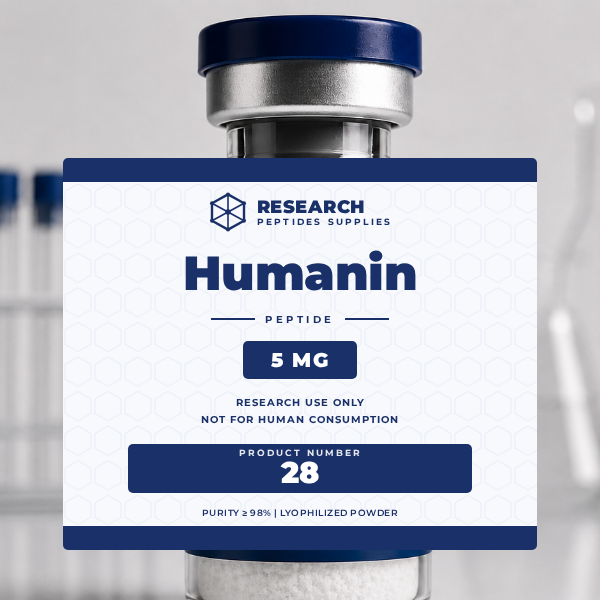
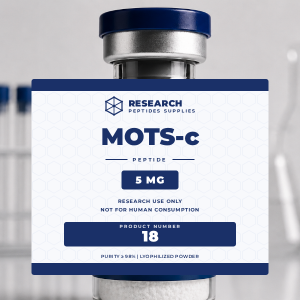
Humanin Research Peptide — Scientific Overview
Humanin is a 21-amino-acid peptide encoded in the 16S rRNA region of human mitochondrial DNA, first identified in 2001 by Nishimoto and colleagues in a screen for genes that protect against neuronal cell death induced by Alzheimer’s disease-associated insults. As the first characterized mitochondria-derived peptide (MDP), Humanin’s discovery established that the mitochondrial genome encodes bioactive peptides with significant effects on cell survival, aging, and metabolism — a paradigm that has since expanded with the identification of additional MDPs including MOTS-c and SHLPs (Small Humanin-Like Peptides).
Humanin circulates in human blood and its plasma levels decline with age, a characteristic shared with MOTS-c and suggesting a broader role for MDPs in aging biology. Research has investigated Humanin’s cytoprotective effects against multiple forms of cell death, its interactions with insulin signaling and metabolic pathways, its neuroprotective properties in Alzheimer’s and ischemia models, and its role in systemic inter-tissue communication as a circulating signal.
Research Background
Published Humanin research covers neuroprotection against amyloid-beta (Aβ) toxicity in Alzheimer’s models, protection against apoptosis via Bax/IGFBP-3 pathway modulation, insulin sensitization and protection against diet-induced metabolic dysfunction in animal models, endothelial cell protection, and age-associated physiological decline investigation. Humanin analogs with enhanced potency (such as HNG — Humanin with Ser14Gly substitution) have also been developed and studied.
Key Research Areas
- Neuroprotection Research: Protection against Aβ toxicity, ischemia, and excitotoxicity in neural models
- Aging Research: MDP biology, age-associated decline, and longevity pathway investigation
- Insulin Signaling Research: Insulin sensitization and metabolic protection in preclinical models
- Apoptosis Research: Bax/IGFBP-3 pathway modulation and cell death protection mechanisms
- Cardiovascular Research: Endothelial cell protection and vascular biology studies
- Mitochondrial Biology Research: Inter-organelle communication and mitokine signaling studies
Technical Specifications
| Parameter |
Value |
| Sequence |
MAPRGFSCLLLLTSEIDLPVKRRA |
| Molecular Weight |
~2.8 kDa |
| Purity |
≥98% (HPLC-verified) |
| Form |
Lyophilized powder, sealed under argon |
| Storage |
−20°C (long-term) |
| Documentation |
Batch-specific COA (HPLC + Mass Spec) |
Storage & Handling (Research Laboratories)
Lyophilized Humanin should be stored at −20°C for long-term preservation, protected from light and moisture. For short-term active research use, 4°C storage is acceptable for up to approximately 4 weeks. Minimize repeated freeze-thaw cycles. Follow standard laboratory peptide reconstitution and handling protocols for all experimental use.
Frequently Asked Questions — Humanin Research
How was Humanin discovered?
Humanin was discovered in 2001 by Ikuo Nishimoto and colleagues at Keio University School of Medicine. During a cDNA library screen for genes capable of protecting neurons from Alzheimer’s disease-associated insults (including familial AD mutations in presenilin-2), they identified a cDNA that was uniquely protective against multiple AD insults. Surprisingly, sequencing revealed this protective cDNA corresponded not to nuclear DNA but to a sequence within the 16S rRNA gene of human mitochondrial DNA — establishing the first mitochondria-derived peptide and opening an entirely new field of MDP biology.
How does Humanin protect against Alzheimer’s-related cellular stress?
Multiple mechanisms have been proposed for Humanin’s protection against Alzheimer’s-associated cell death. Research has documented: (1) Direct binding to amyloid-beta (Aβ) peptides that neutralizes their toxic aggregation; (2) Activation of STAT3 pathway through a receptor complex involving IL-6R, WSX-1, and gp130; (3) Suppression of IGFBP-3 (insulin-like growth factor binding protein-3), which is a pro-apoptotic factor in certain AD-related death pathways; (4) Mitochondrial protective effects against oxidative stress. These findings are from in vitro and animal model studies.
What is the relationship between Humanin and MOTS-c?
Humanin and MOTS-c are both mitochondria-derived peptides (MDPs) encoded by the human mitochondrial genome — Humanin from the 16S rRNA region and MOTS-c from the 12S rRNA region. Together with the SHLPs (Small Humanin-Like Peptides), they represent a growing family of bioactive mitochondrial peptides with systemic signaling roles. Both peptides decline with age in human plasma, both show metabolic regulatory effects, and both have demonstrated cytoprotective properties in animal models. Research comparing their mechanisms and interactions is an active area of MDP biology.
Is Humanin approved for human use?
No. Humanin is not approved by the FDA or any regulatory authority for human therapeutic use. It is an investigational research compound supplied by Research Peptides Supplies exclusively for qualified laboratory research in controlled settings. It is not for human administration in any context.
What documentation is provided with Humanin?
Humanin from Research Peptides Supplies is independently verified at ≥98% purity by HPLC, with molecular identity confirmed by Mass Spectrometry. A batch-specific COA documenting lot number, purity results, and mass verification is provided with every order.
⚗️ Research Use Only: This product is strictly intended for qualified laboratory and scientific research use by trained professionals in appropriate laboratory settings. It is not intended for human or veterinary administration, therapeutic use, food supplement applications, or any use outside controlled research environments. Not for human consumption.