Follistatin-344 Research Peptide — Scientific Overview
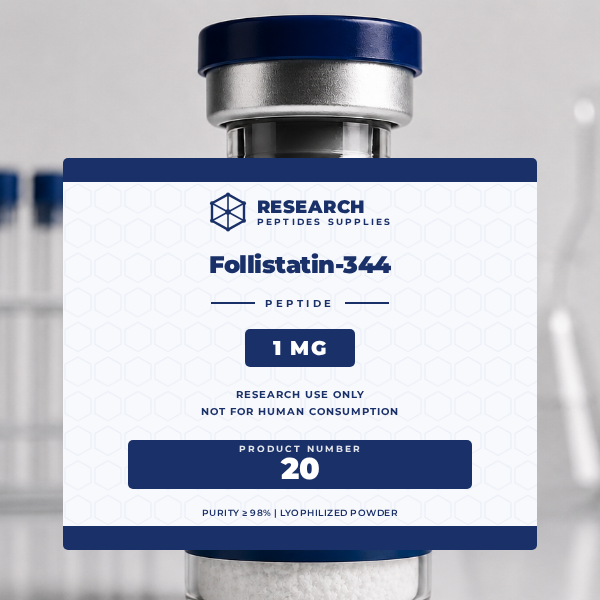
Follistatin-344 is a recombinant isoform of Follistatin — a naturally occurring glycoprotein that acts as a potent antagonist of multiple TGF-β superfamily members, most notably myostatin (GDF-8) and activin. Follistatin is produced in numerous tissues and plays critical regulatory roles in muscle mass maintenance, reproductive biology, and embryonic development. The 344 designation refers to the amino acid isoform produced by alternative splicing of the FST gene, one of the primary circulating isoforms in human blood.
Myostatin is a negative regulator of skeletal muscle mass — natural mutations causing myostatin deficiency in animals and rare human cases produce dramatically elevated muscle mass with normal or reduced fat tissue. Follistatin’s capacity to neutralize myostatin through high-affinity binding makes it a key research tool for studying muscle biology, myostatin signaling pathways, and the therapeutic potential of myostatin inhibition in muscle-wasting disease models.
Research Background
Research into Follistatin-344 spans skeletal muscle biology (myostatin pathway), reproductive biology (FSH regulation, ovarian follicle development), oncology research (activin signaling in cancer), and developmental biology. Notable research includes gene therapy studies using Follistatin gene transfer to produce significant skeletal muscle hypertrophy in both animal models and early-phase human gene therapy trials for Becker muscular dystrophy.
Key Research Areas
- Myostatin Research: GDF-8 neutralization and muscle mass regulatory pathway studies
- Muscle Biology Research: Skeletal muscle hypertrophy mechanisms and atrophy prevention in animal models
- Reproductive Research: FSH regulation, ovarian biology, and activin pathway modulation
- TGF-β Superfamily Research: Activin/inhibin/BMP signaling pathway investigation
- Gene Therapy Research: Follistatin gene transfer and muscle-directed gene therapy studies
- Muscle Disease Research: Duchenne/Becker MD, sarcopenia, and muscle wasting preclinical models
Technical Specifications
| Parameter |
Value |
| Isoform |
Follistatin-344 (FS-344; 344 amino acid isoform) |
| Molecular Weight |
~35 kDa (monomer, glycosylated) |
| Purity |
≥95% (SDS-PAGE verified) |
| Form |
Lyophilized, sterile-filtered |
| Storage |
−20°C (long-term); avoid repeated freeze-thaw |
| Documentation |
Batch-specific COA (SDS-PAGE + activity assay) |
Storage & Handling (Research Laboratories)
Lyophilized Follistatin-344 should be stored at −20°C for long-term preservation, protected from light and moisture. For short-term active research use, 4°C storage is acceptable for up to approximately 4 weeks. Minimize repeated freeze-thaw cycles. Follow standard laboratory peptide reconstitution and handling protocols for all experimental use.
Frequently Asked Questions — Follistatin-344 Research
What is myostatin and why is its inhibition important for muscle research?
Myostatin (GDF-8 — Growth Differentiation Factor 8) is a TGF-β superfamily member that acts as the body’s primary negative regulator of skeletal muscle mass. It signals through ActRIIB receptors on muscle cells to suppress muscle satellite cell proliferation, differentiation, and protein synthesis — effectively limiting muscle growth. Natural mutations causing myostatin loss-of-function produce dramatic muscle hypertrophy (double-muscled cattle, extraordinary muscularity in rare human cases). Follistatin-344 is studied as a research tool to inhibit myostatin in animal models, providing insight into muscle growth regulation and potential approaches to muscle wasting diseases.
How does Follistatin neutralize myostatin?
Follistatin neutralizes myostatin through high-affinity direct binding that prevents myostatin from binding to its receptor (ActRIIB). Follistatin’s three cysteine-rich follistatin domains (FSD1, FSD2, FSD3) form a ring structure around myostatin, occluding both the type I and type II receptor binding sites. This complete receptor blockade renders myostatin biologically inactive. Follistatin binds myostatin with sub-nanomolar affinity (Kd ~0.07 nM), making it one of the highest-affinity natural myostatin inhibitors. Researchers use recombinant Follistatin-344 to study the consequences of myostatin neutralization in various cell and animal models.
What reproductive biology research has been conducted with Follistatin?
Follistatin was originally identified not in muscle biology but in reproductive research — it was discovered as a follicle-stimulating hormone (FSH)-suppressing protein from ovarian follicular fluid. By neutralizing activin (which stimulates FSH secretion from the pituitary), Follistatin modulates the hypothalamic-pituitary-gonadal axis. Research has examined Follistatin’s role in ovarian follicle development, FSH regulation during the menstrual cycle, and activin’s paracrine functions in reproductive tissues. FSH-Follistatin interactions are studied as targets for potential contraceptive and fertility research.
Is Follistatin-344 approved for human use?
No. Recombinant Follistatin-344 is not approved for human therapeutic use by the FDA or any regulatory authority. A Follistatin gene therapy (rAAV1.CMV.huFollistatin344) has been investigated in early-phase clinical trials for Becker muscular dystrophy, but this is experimental research. Recombinant Follistatin-344 protein is supplied by Research Peptides Supplies strictly for qualified laboratory research use.
What documentation accompanies Follistatin-344 from Research Peptides Supplies?
Follistatin-344 comes with a batch-specific COA confirming protein identity and purity by SDS-PAGE analysis. Activity verification is included where available. Lot traceability and testing methodology documentation is provided with each order.
⚗️ Research Use Only: This product is strictly intended for qualified laboratory and scientific research use by trained professionals in appropriate laboratory settings. It is not intended for human or veterinary administration, therapeutic use, food supplement applications, or any use outside controlled research environments. Not for human consumption.