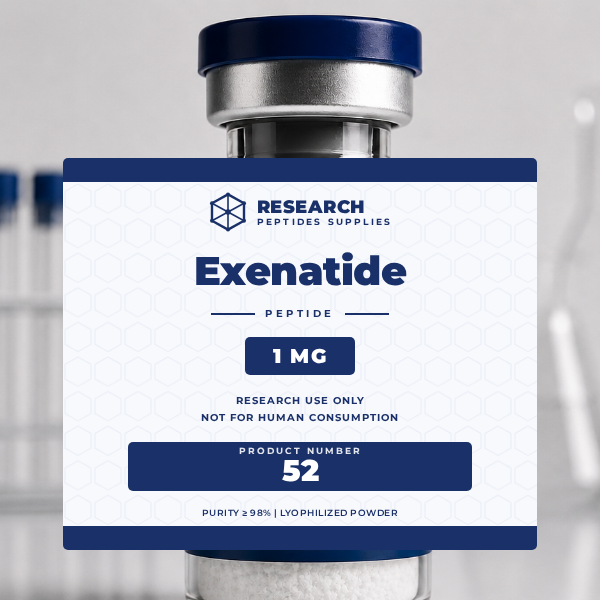
Exenatide Research Peptide — Scientific Overview
Exenatide is a 39-amino-acid peptide derived from exendin-4, a naturally occurring peptide originally isolated from the saliva of the Gila monster (Heloderma suspectum). It was the first GLP-1 receptor agonist approved by the FDA (2005) for Type 2 diabetes treatment, establishing the class. Exenatide shares approximately 53% sequence homology with human GLP-1 but, unlike native GLP-1, is not susceptible to DPP-4 cleavage — giving it a substantially longer half-life. It is available as twice-daily (Byetta®) and once-weekly extended-release (Bydureon®) formulations.
Exenatide is a 39-amino-acid peptide derived from exendin-4, a naturally occurring peptide originally isolated from the saliva of the Gila monster (Heloderma suspectum). It was the first GLP-1 receptor agonist approved by the FDA (2005) for Type 2 diabetes treatment, establishing the class. Exenatide shares approximately 53% sequence homology with human GLP-1 but, unlike native GLP-1, is not susceptible to DPP-4 cleavage — giving it a substantially longer half-life. It is available as twice-daily (Byetta®) and once-weekly extended-release (Bydureon®) formulations. As the founding member of the GLP-1 receptor agonist class, Exenatide has generated the broadest preclinical research literature — with documented effects in models of Type 2 diabetes, obesity, non-alcoholic fatty liver disease, Parkinson’s disease neuroprotection, Alzheimer’s disease models, and kidney protection. Its use as a research comparator standard is well-established across metabolic and neuroprotection research domains.
Research Background
As the founding member of the GLP-1 receptor agonist class, Exenatide has generated the broadest preclinical research literature — with documented effects in models of Type 2 diabetes, obesity, non-alcoholic fatty liver disease, Parkinson’s disease neuroprotection, Alzheimer’s disease models, and kidney protection. Its use as a research comparator standard is well-established across metabolic and neuroprotection research domains.
Key Research Areas
- GLP-1R Pharmacology Research: Foundational GLP-1 receptor agonism studies and receptor biology
- Metabolic Research: Glycemic control, insulin secretion, and β-cell protection models
- Neuroprotection Research: Parkinson’s, Alzheimer’s, and neuroinflammation research in animal models
- Obesity Research: GLP-1R-mediated appetite suppression and body weight reduction
- NASH/NAFLD Research: Liver steatosis and hepatic inflammation research models
- Renal Research: Kidney protection and GLP-1R renal signaling
Technical Specifications
| Parameter | Value |
|---|---|
| Sequence | His-Gly-Glu-Gly-Thr-Phe-Thr-Ser-Asp-Leu-Ser-Lys-Gln-Met-Glu-Glu-Glu-Ala-Val-Arg-Leu-Phe-Ile-Glu-Trp-Leu-Lys-Asn-Gly-Gly-Pro-Ser-Ser-Gly-Ala-Pro-Pro-Pro-Ser (39 AA) |
| Molecular Weight | 4186.6 Da |
| Purity | ≥98% (HPLC-verified) |
| Form | Lyophilized powder, sealed under argon |
| Storage | −20°C (long-term) |
| Documentation | Batch-specific COA (HPLC + Mass Spec) |
Storage & Handling (Research Laboratories)
Lyophilized Exenatide should be stored at −20°C for long-term preservation, protected from light and moisture. For short-term active research use, 4°C storage is acceptable for up to approximately 4 weeks. Minimize repeated freeze-thaw cycles. Follow standard laboratory peptide reconstitution and handling protocols for all experimental use.