Pemvidutide Research Peptide — Scientific Overview
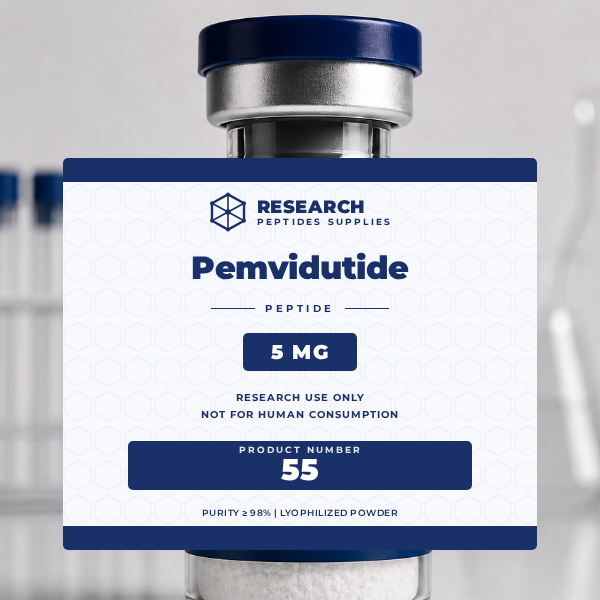
Pemvidutide (ALT-801) is a dual GLP-1 and glucagon receptor agonist developed by Altimmune that is distinguished within its class by its relatively high glucagon receptor (GCGR) agonism potency compared to other GLP-1/glucagon dual agonists. Pemvidutide is designed as a weekly subcutaneous peptide with balanced GLP-1R and GCGR activity. Its notably high glucagon component drives hepatic fat mobilization, thermogenesis, and potentially muscle protein preservation through effects on hepatic amino acid metabolism.
Pemvidutide (ALT-801) is a dual GLP-1 and glucagon receptor agonist developed by Altimmune that is distinguished within its class by its relatively high glucagon receptor (GCGR) agonism potency compared to other GLP-1/glucagon dual agonists. Pemvidutide is designed as a weekly subcutaneous peptide with balanced GLP-1R and GCGR activity. Its notably high glucagon component drives hepatic fat mobilization, thermogenesis, and potentially muscle protein preservation through effects on hepatic amino acid metabolism. In Phase II clinical trials (MOMENTUM), Pemvidutide showed significant body weight reduction (approximately 15% over 48 weeks) with a distinctive feature: preservation of lean mass (muscle) relative to total weight lost. Analysis of body composition data showed that a greater proportion of weight loss was from fat mass rather than lean mass compared to GLP-1 agonist monotherapy controls. This lean mass-sparing property — hypothesized to result from glucagon’s anabolic effects on protein metabolism — is a key differentiator being investigated for Pemvidutide in obesity and sarcopenic obesity research.
Research Background
In Phase II clinical trials (MOMENTUM), Pemvidutide showed significant body weight reduction (approximately 15% over 48 weeks) with a distinctive feature: preservation of lean mass (muscle) relative to total weight lost. Analysis of body composition data showed that a greater proportion of weight loss was from fat mass rather than lean mass compared to GLP-1 agonist monotherapy controls. This lean mass-sparing property — hypothesized to result from glucagon’s anabolic effects on protein metabolism — is a key differentiator being investigated for Pemvidutide in obesity and sarcopenic obesity research.
Key Research Areas
- Dual GLP-1/Glucagon Research: High-ratio GCGR:GLP-1R activation and downstream metabolic effects
- Body Composition Research: Fat loss with lean mass preservation — muscle biology in weight loss models
- MASH Research: Hepatic fat mobilization, fibrosis reduction, and liver biology
- Obesity Research: Weight reduction mechanisms and adipose tissue biology
- Muscle Preservation Research: Anti-catabolic effects of glucagon receptor agonism on skeletal muscle
- Thermogenesis Research: Glucagon-driven energy expenditure and brown adipose tissue activation
Technical Specifications
| Parameter | Value |
|---|---|
| Classification | Dual GLP-1/Glucagon receptor agonist (ALT-801) — high glucagon ratio |
| Developer | Altimmune |
| Purity | ≥98% (HPLC-verified) |
| Form | Lyophilized powder, sealed under argon |
| Storage | −20°C (long-term) |
| Documentation | Batch-specific COA (HPLC + Mass Spec) |
Storage & Handling (Research Laboratories)
Lyophilized Pemvidutide should be stored at −20°C for long-term preservation, protected from light and moisture. For short-term active research use, 4°C storage is acceptable for up to approximately 4 weeks. Minimize repeated freeze-thaw cycles. Follow standard laboratory peptide reconstitution and handling protocols for all experimental use.