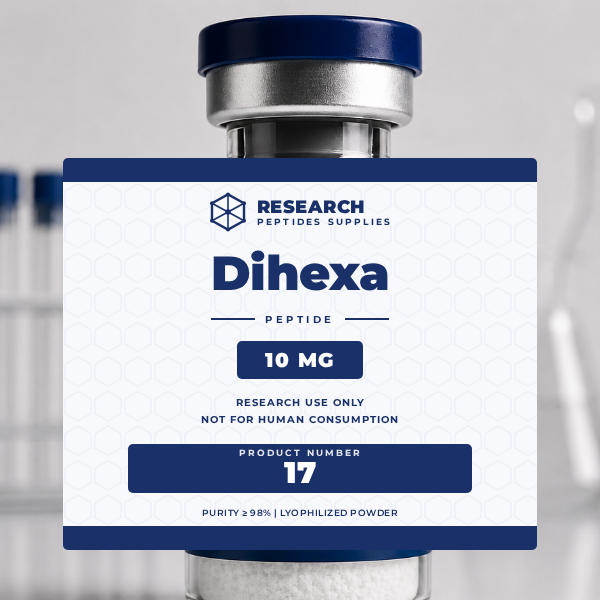
Dihexa Research Peptide — Scientific Overview
Dihexa (N-hexanoic-Tyr-Ile-(6)-aminohexanoic acid amide) is a small-molecule peptidomimetic derived from the angiotensin IV (AngIV) sequence, developed by Joseph Harding, John Wright, and colleagues at Washington State University’s neuroscience program. Unlike typical peptides, Dihexa is designed as a brain-penetrant, orally active compound with high potency in preclinical cognitive research models. A foundational 2013 publication in the Journal of Pharmacology and Experimental Therapeutics reported that Dihexa was approximately 7 orders of magnitude more potent than BDNF in facilitating synaptogenesis in hippocampal cell culture models.
Dihexa operates primarily through the HGF (hepatocyte growth factor) / c-Met receptor pathway — a key regulator of neuronal survival, synaptogenesis, and hippocampal plasticity. Research has shown Dihexa binds to HGF with high affinity, potentiating HGF/c-Met signaling to enhance new synapse formation. Its small molecular size, lipophilicity, and enzymatic stability make it particularly useful for research into blood-brain barrier-penetrant cognitive agents.
Research Background
The primary body of published Dihexa research comes from Washington State University, with studies examining cognitive function in aging rodent models, Alzheimer’s disease-related models, and spatial memory tasks. Dihexa has been shown to reverse cognitive deficits induced by scopolamine, bilateral nephrectomy, and aging in rodent tests. More recent research interest has expanded to include Dihexa’s potential role in cardiac biology and non-cognitive applications of HGF/c-Met pathway modulation.
Key Research Areas
- Cognitive Research: Spatial memory, learning, and procognitive effects in rodent behavioral models
- HGF/c-Met Research: Hepatocyte growth factor pathway potentiation and synaptogenesis studies
- Neuroplasticity Research: Hippocampal synapse formation and dendritic spine density investigations
- Alzheimer’s Model Research: Cognitive deficit reversal studies in amyloid and scopolamine models
- Aging Research: Age-related cognitive decline investigation in rodent models
- Blood-Brain Barrier Research: CNS-penetrant peptidomimetic pharmacology and brain delivery studies
Technical Specifications
| Parameter |
Value |
| Classification |
Angiotensin IV analog (peptidomimetic) |
| Molecular Weight |
~450 Da |
| Purity |
≥98% (HPLC-verified) |
| Form |
Lyophilized powder, sealed under argon |
| Storage |
−20°C (long-term); 4°C (short-term) |
| Documentation |
Batch-specific COA (HPLC + Mass Spec) |
Storage & Handling (Research Laboratories)
Lyophilized Dihexa should be stored at −20°C for long-term preservation, protected from light and moisture. For short-term active research use, 4°C storage is acceptable for up to approximately 4 weeks. Minimize repeated freeze-thaw cycles. Follow standard laboratory peptide reconstitution and handling protocols for all experimental use.
Frequently Asked Questions — Dihexa Research
What makes Dihexa unique compared to other cognitive research peptides?
Dihexa is notable for several reasons: (1) It is a peptidomimetic rather than a standard peptide — a small molecule designed to retain the bioactivity of a peptide while gaining improved pharmacokinetic properties including oral bioavailability and blood-brain barrier penetrance; (2) Its mechanism operates through the HGF/c-Met pathway — a relatively understudied but important regulator of neuroplasticity — rather than classical neurotransmitter pathways; (3) Its published potency in synaptogenesis assays (reportedly 7 orders of magnitude more potent than BDNF in one assay) makes it an extremely high-interest research compound among neuroscience investigators.
How does Dihexa interact with the HGF/c-Met pathway?
Dihexa binds directly to hepatocyte growth factor (HGF) and potentiates its interaction with the c-Met receptor — a tyrosine kinase receptor expressed on neurons, endothelial cells, and other cell types. HGF/c-Met signaling regulates cell growth, survival, synaptogenesis, and migration. In the brain, c-Met activation in hippocampal neurons promotes dendritic arborization, synapse formation, and long-term potentiation — processes critical for learning and memory. Dihexa’s high-affinity HGF binding and its ability to penetrate the blood-brain barrier make it a valuable tool for studying this pathway in living animals.
What behavioral tests have been used in Dihexa research?
Published Dihexa research in rodent models has employed spatial memory tests including the Morris Water Maze and radial arm maze, as well as passive avoidance paradigms and novel object recognition tasks. Studies in aging rats and in scopolamine-induced amnestic models have documented significant cognitive improvements in Dihexa-treated groups compared to vehicle controls. It should be noted that rodent behavioral models do not directly translate to human cognitive outcomes.
Is Dihexa approved for human use?
No. Dihexa has not received FDA approval or any regulatory clearance for human use. It is an investigational research compound supplied strictly for qualified laboratory research by trained professionals in controlled settings. It is not for human administration, self-experimentation, or any use outside research contexts.
What documentation comes with Dihexa from Research Peptides Supplies?
Dihexa from Research Peptides Supplies is verified at ≥98% purity by HPLC with identity confirmed by Mass Spectrometry. A batch-specific COA documenting lot number, purity result, mass data, and testing methodology is included with every order.
⚗️ Research Use Only: This product is strictly intended for qualified laboratory and scientific research use by trained professionals in appropriate laboratory settings. It is not intended for human or veterinary administration, therapeutic use, food supplement applications, or any use outside controlled research environments. Not for human consumption.