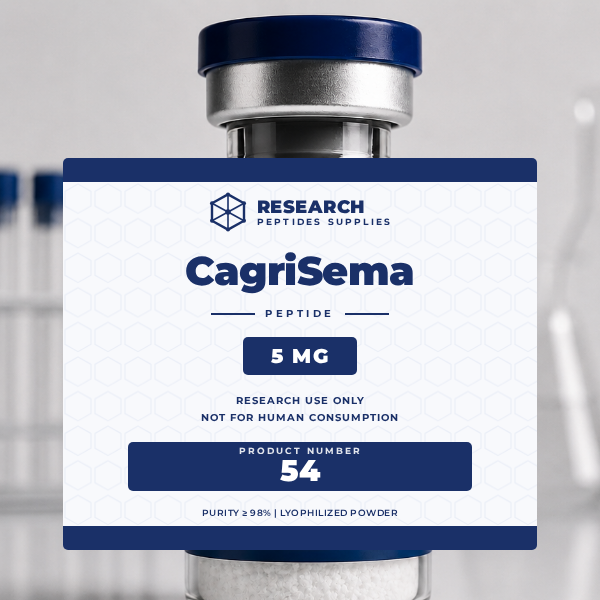
CagriSema Research Peptide — Scientific Overview
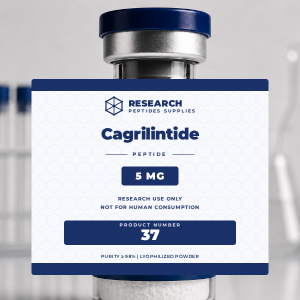
CagriSema is a fixed-ratio combination product developed by Novo Nordisk consisting of Cagrilintide (a long-acting amylin analog) co-formulated with semaglutide (a GLP-1 receptor agonist) for once-weekly subcutaneous injection. The combination exploits two complementary weight-regulating mechanisms: GLP-1 receptor agonism (appetite suppression via hypothalamic pathways, slowed gastric emptying, and insulin secretion augmentation) and amylin receptor agonism (additional satiety signaling through area postrema and nucleus accumbens pathways, additional slowing of gastric emptying, and post-meal glucagon suppression).
CagriSema is a fixed-ratio combination product developed by Novo Nordisk consisting of Cagrilintide (a long-acting amylin analog) co-formulated with semaglutide (a GLP-1 receptor agonist) for once-weekly subcutaneous injection. The combination exploits two complementary weight-regulating mechanisms: GLP-1 receptor agonism (appetite suppression via hypothalamic pathways, slowed gastric emptying, and insulin secretion augmentation) and amylin receptor agonism (additional satiety signaling through area postrema and nucleus accumbens pathways, additional slowing of gastric emptying, and post-meal glucagon suppression). CagriSema is being evaluated in the REDEFINE Phase III clinical trial program for obesity (BMI ≥ 30 kg/m² or ≥ 27 kg/m² with comorbidities) and in combination metabolic disease trials. Phase III REDEFINE data has reported approximately 22.7% mean body weight reduction versus approximately 8% for placebo at 68 weeks — greater than semaglutide alone (approximately 15% in STEP trials) — supporting the additive efficacy hypothesis of dual amylin/GLP-1 mechanism therapy.
Research Background
CagriSema is being evaluated in the REDEFINE Phase III clinical trial program for obesity (BMI ≥ 30 kg/m² or ≥ 27 kg/m² with comorbidities) and in combination metabolic disease trials. Phase III REDEFINE data has reported approximately 22.7% mean body weight reduction versus approximately 8% for placebo at 68 weeks — greater than semaglutide alone (approximately 15% in STEP trials) — supporting the additive efficacy hypothesis of dual amylin/GLP-1 mechanism therapy.
Key Research Areas
- Combined Amylin/GLP-1 Research: GLP-1R + amylin receptor dual pathway activation studies
- Obesity Research: Maximum weight reduction mechanisms in metabolic research models
- Satiety Biology Research: Multi-pathway satiety signaling from complementary neuropeptide systems
- Metabolic Research: Glycemic control, insulin sensitivity, and cardiometabolic risk factor modulation
- Gastric Motility Research: Dual-mechanism gastric emptying inhibition from amylin + GLP-1 pathways
- Combination Pharmacology: Amylin + GLP-1 receptor agonist synergy studies
Technical Specifications
| Parameter | Value |
|---|---|
| Classification | Fixed-ratio combination: Cagrilintide (amylin analog) + Semaglutide (GLP-1 RA) |
| Developer | Novo Nordisk |
| Purity | ≥98% (HPLC-verified, individual components) |
| Form | Lyophilized powder (individual components), sealed under argon |
| Storage | −20°C (long-term) |
| Documentation | Batch-specific COA (HPLC + Mass Spec for each component) |
Storage & Handling (Research Laboratories)
Lyophilized CagriSema should be stored at −20°C for long-term preservation, protected from light and moisture. For short-term active research use, 4°C storage is acceptable for up to approximately 4 weeks. Minimize repeated freeze-thaw cycles. Follow standard laboratory peptide reconstitution and handling protocols for all experimental use.