⌕♙🛒

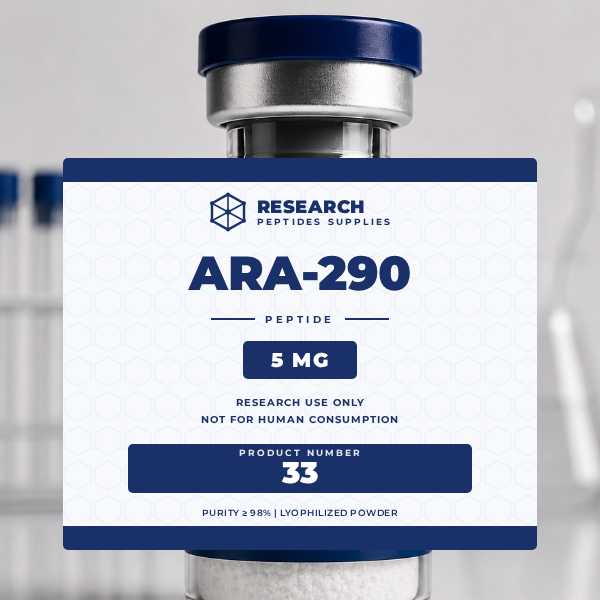
ARA-290

$54.99

ARA-290 — a non-erythropoietic 11-amino-acid peptide derived from the helix B surface of erythropoietin (EPO). Specifically designed to activate only the innate repair receptor without activating the EPO receptor — enabling tissue protection research without hematopoietic effects. Supplied lyophilized at ≥98% purity (HPLC-verified) with batch-specific COA. For research use only.

SKU: RPS-ARA290-001 Category: Tags: ,

ARA-290 Research Peptide — Scientific Overview

ARA-290 (also known as Cibinetide) is a synthetic 11-amino-acid peptide derived from the helix B surface of erythropoietin (EPO) — specifically the portion of EPO that interacts with the β-common receptor/innate repair receptor (IRR) complex without engaging the classical EPO receptor (EPOR homodimer). This selective receptor activation profile is the defining feature of ARA-290: it activates the tissue-protective signaling of EPO (via the IRR) while avoiding the hematopoietic (red blood cell-stimulating) effects that limit therapeutic EPO use.

The development of ARA-290 arose from research demonstrating that EPO has two distinct receptor systems with different downstream effects: (1) The EPOR homodimer — responsible for EPO’s hematopoietic effects (red blood cell production) and associated with adverse effects including thromboembolic events; and (2) The β-common receptor/IRR heterodimer — responsible for EPO’s tissue-protective, anti-inflammatory, and neuroprotective effects. ARA-290 was engineered to activate only the IRR pathway, enabling investigation of EPO’s tissue-protective pharmacology without hematopoietic confounds.

Research Background

ARA-290 has advanced through multiple clinical trials. Most notably, it was investigated by Araim Pharmaceuticals for sarcoidosis-associated peripheral neuropathy — a condition involving immune-mediated nerve damage for which no approved treatment existed. Phase II results published in Annals of the American Thoracic Society (2014) demonstrated statistically significant improvements in peripheral nerve fiber density (corneal confocal microscopy) and reduction in neuropathic pain scores, establishing proof-of-concept for ARA-290 in human neuropathy.

Key Research Areas

  • Neuroprotection Research: Peripheral nerve protection, corneal nerve density, and neuropathic pain studies
  • Innate Repair Receptor Research: IRR/β-common receptor biology and tissue-protective EPO signaling
  • Anti-Inflammatory Research: Macrophage polarization, cytokine modulation, and tissue inflammation resolution
  • Metabolic Research: Insulin sensitivity, pancreatic β-cell protection, and glucose metabolism studies
  • Cardiac Research: Cardiac ischemia protection through non-hematopoietic EPO receptor activation
  • Sarcoidosis Research: Granulomatous disease biology and organ-specific inflammatory studies

Technical Specifications

Parameter Value
Classification Non-erythropoietic EPO helix-B-derived peptide (11 AA)
Molecular Weight ~1.3 kDa
Purity ≥98% (HPLC-verified)
Form Lyophilized powder, sealed under argon
Storage −20°C (long-term)
Documentation Batch-specific COA (HPLC + Mass Spec)

Storage & Handling (Research Laboratories)

Lyophilized ARA-290 should be stored at −20°C for long-term preservation, protected from light and moisture. For short-term active research use, 4°C storage is acceptable for up to approximately 4 weeks. Minimize repeated freeze-thaw cycles. Follow standard laboratory peptide reconstitution and handling protocols for all experimental use.
Frequently Asked Questions — ARA-290 Research

What is the innate repair receptor (IRR) and how does ARA-290 selectively activate it?
The innate repair receptor (IRR) is a heterodimeric complex of the EPO receptor (EPOR) and the β-common receptor (βCR/CD131) expressed on multiple tissue types including neurons, immune cells, pancreatic β-cells, and endothelial cells. It mediates EPO’s tissue-protective, anti-inflammatory, and regenerative effects independently of hematopoiesis. ARA-290 was designed from the helix B surface of EPO — the region that preferentially engages βCR — to activate the EPOR/βCR IRR without activating the EPOR homodimer that drives hematopoiesis. This receptor selectivity was validated in vitro, in knockout mouse models, and confirmed by ARA-290’s lack of erythropoietic activity in clinical studies.
What clinical evidence exists for ARA-290 in peripheral neuropathy?
A Phase II randomized trial of ARA-290 in sarcoidosis-associated small fiber peripheral neuropathy (Brines et al., 2014, Ann ATS) enrolled 64 patients. The primary endpoint was change in corneal nerve fiber density by confocal microscopy — a validated objective measure of small fiber neuropathy. ARA-290-treated subjects showed statistically significant increases in corneal nerve fiber density versus placebo, accompanied by significant improvements in neuropathic pain scores (NRS) and measures of autonomic function. This represents a rare example of a randomized trial demonstrating objective nerve regeneration in peripheral neuropathy.
What anti-inflammatory mechanisms does ARA-290 activate?
ARA-290 activates the IRR on macrophages to promote a shift toward an anti-inflammatory M2 (alternatively activated) phenotype. Research has documented decreased production of pro-inflammatory cytokines (TNF-α, IL-6, IL-1β) and increased anti-inflammatory markers (IL-10, arginase-1) in ARA-290-treated macrophage models. In granuloma-forming models relevant to sarcoidosis, ARA-290 has been shown to reduce granuloma size and inflammatory infiltration. These anti-inflammatory properties may be relevant to multiple disease contexts beyond neuropathy.
Is ARA-290 approved for human use?
ARA-290 has not received FDA approval. It remains investigational following Phase II clinical trials. Research Peptides Supplies supplies ARA-290 for qualified laboratory research use only.
What documentation comes with ARA-290?
ARA-290 from Research Peptides Supplies is verified at ≥98% purity by HPLC with identity confirmed by Mass Spectrometry. A batch-specific COA is provided with every order.
⚗️ Research Use Only: This product is strictly intended for qualified laboratory and scientific research use by trained professionals in appropriate laboratory settings. It is not intended for human or veterinary administration, therapeutic use, food supplement applications, or any use outside controlled research environments. Not for human consumption.
Shopping Cart
Scroll to Top