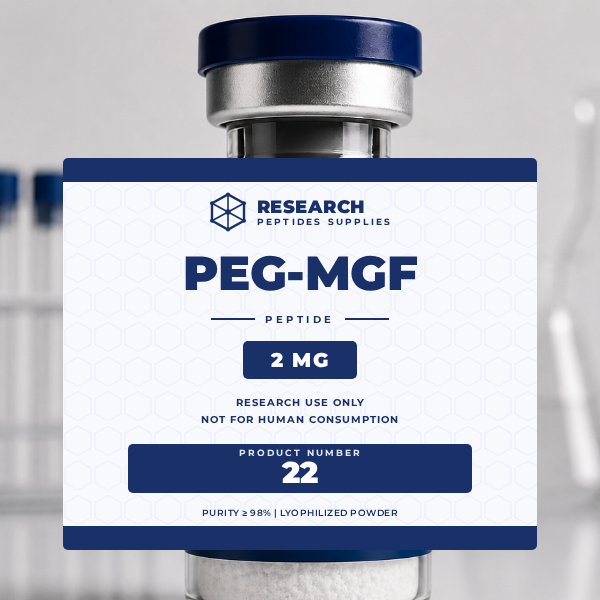
PEG-MGF (Pegylated Mechano Growth Factor) Research Peptide — Scientific Overview
PEG-MGF refers to a PEGylated (polyethylene glycol-conjugated) form of the Mechano Growth Factor E-peptide — the biologically active C-terminal peptide unique to the MGF splice variant of IGF-1. PEGylation is a well-established pharmaceutical technology that attaches polyethylene glycol (PEG) chains to peptides and proteins to protect them from proteolytic degradation, reduce renal clearance, and dramatically extend circulating half-life. The MGF E-peptide without PEGylation is rapidly degraded in plasma (half-life of minutes), while PEG-MGF has an extended half-life that allows more sustained biological effects in in vivo research models.
PEGylation of the MGF E-peptide preserves the peptide’s receptor-binding characteristics while dramatically improving its pharmacokinetic profile for animal research. This extended half-life makes PEG-MGF more practical for in vivo studies where repeated frequent dosing of the non-PEGylated form would be impractical. Research with PEG-MGF has examined muscle hypertrophy, satellite cell biology, post-damage muscle regeneration, and cardiac protection studies.
Research Background
Published research has compared non-PEGylated MGF E-peptide with PEG-MGF to characterize the pharmacokinetic impact of PEGylation on MGF biology. Studies in rodent models have examined PEG-MGF’s effects on muscle fiber diameter, satellite cell number, and functional outcomes following muscle injury, providing insight into sustained E-peptide biology that cannot be studied with the rapidly-degraded native form.
Key Research Areas
- Muscle Biology Research: Sustained MGF E-peptide effects on muscle hypertrophy and satellite cell activation
- PEGylation Research: Pharmacokinetic studies of PEG modification on peptide half-life and bioavailability
- Post-Injury Research: Muscle regeneration studies with extended E-peptide exposure after damage
- Cardiac Research: Extended MGF E-peptide effects in cardiac protection models
- Satellite Cell Research: Prolonged satellite cell activation studies using sustained PEG-MGF exposure
- In Vivo Pharmacology: PEGylated peptide biology in animal models vs. rapid non-PEGylated forms
Technical Specifications
| Parameter | Value |
|---|---|
| Classification | PEGylated MGF C-terminal E-peptide |
| Molecular Weight | ~2.9 kDa (peptide) + PEG chain (~2-40 kDa depending on PEG size) |
| Purity | ≥98% (HPLC-verified) |
| Form | Lyophilized powder, sealed under argon |
| Storage | −20°C (long-term) |
| Documentation | Batch-specific COA (HPLC + Mass Spec) |
Storage & Handling (Research Laboratories)
Lyophilized PEG-MGF (Pegylated Mechano Growth Factor) should be stored at −20°C for long-term preservation, protected from light and moisture. For short-term active research use, 4°C storage is acceptable for up to approximately 4 weeks. Minimize repeated freeze-thaw cycles. Follow standard laboratory peptide reconstitution and handling protocols for all experimental use.