Noopept Research Peptide — Scientific Overview
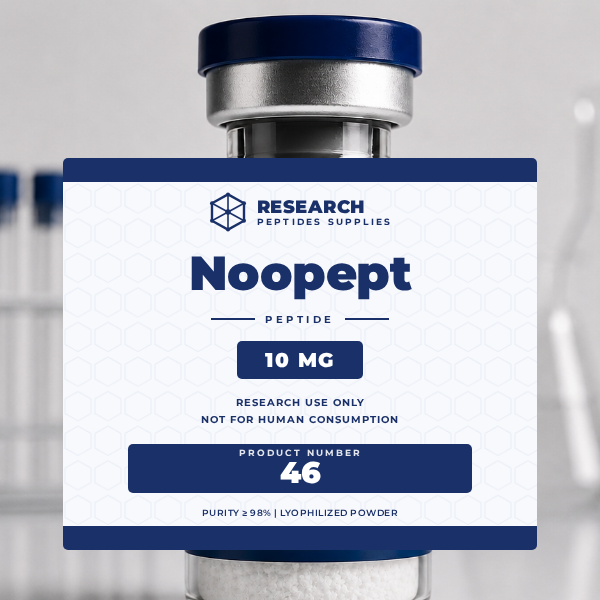
Noopept (N-phenylacetyl-L-prolylglycine ethyl ester, GVS-111) is a synthetic dipeptide nootropic developed by researchers at the Zakusov Institute of Pharmacology (Russia) as an orally bioavailable proline-containing dipeptide with cognitive-enhancing effects. Unlike many peptides, Noopept is notable for its oral bioavailability — it crosses the intestinal barrier and blood-brain barrier intact or as an active metabolite (cycloprolylglycine), which is itself active at AMPA and NMDA glutamate receptors.
Noopept (N-phenylacetyl-L-prolylglycine ethyl ester, GVS-111) is a synthetic dipeptide nootropic developed by researchers at the Zakusov Institute of Pharmacology (Russia) as an orally bioavailable proline-containing dipeptide with cognitive-enhancing effects. Unlike many peptides, Noopept is notable for its oral bioavailability — it crosses the intestinal barrier and blood-brain barrier intact or as an active metabolite (cycloprolylglycine), which is itself active at AMPA and NMDA glutamate receptors. Noopept’s research profile is characterized by memory-enhancing effects in multiple rodent behavioral paradigms (Morris water maze, passive avoidance, conditioned place preference), neuroprotective properties against oxidative stress and neurotoxic insults, and upregulation of both Nerve Growth Factor (NGF) and Brain-Derived Neurotrophic Factor (BDNF) gene expression in the hippocampus. Its putative active metabolite cycloprolylglycine has been independently characterized as an endogenous neuropeptide, lending mechanistic plausibility to its observed effects.
Research Background
Noopept’s research profile is characterized by memory-enhancing effects in multiple rodent behavioral paradigms (Morris water maze, passive avoidance, conditioned place preference), neuroprotective properties against oxidative stress and neurotoxic insults, and upregulation of both Nerve Growth Factor (NGF) and Brain-Derived Neurotrophic Factor (BDNF) gene expression in the hippocampus. Its putative active metabolite cycloprolylglycine has been independently characterized as an endogenous neuropeptide, lending mechanistic plausibility to its observed effects.
Key Research Areas
- Memory Research: Spatial memory, associative learning, and passive avoidance paradigms
- BDNF/NGF Research: Neurotrophin gene expression upregulation in hippocampus and cortex
- Neuroprotection Research: Glutamate excitotoxicity, oxidative stress, and amyloid model protection
- AMPA/NMDA Research: Glutamate receptor modulation and synaptic plasticity studies
- Oral Bioavailability Research: CNS-penetrant peptide pharmacokinetics and dipeptide transport
- Neuroplasticity Research: Dendritic arborization and synaptic density in memory circuit models
Technical Specifications
| Parameter | Value |
|---|---|
| Chemical Name | N-phenylacetyl-L-prolylglycine ethyl ester (GVS-111) |
| Molecular Weight | 318.4 Da |
| Purity | ≥98% (HPLC-verified) |
| Form | Lyophilized powder, sealed under argon |
| Storage | −20°C (long-term), protect from moisture |
| Documentation | Batch-specific COA (HPLC + Mass Spec) |
Storage & Handling (Research Laboratories)
Lyophilized Noopept should be stored at −20°C for long-term preservation, protected from light and moisture. For short-term active research use, 4°C storage is acceptable for up to approximately 4 weeks. Minimize repeated freeze-thaw cycles. Follow standard laboratory peptide reconstitution and handling protocols for all experimental use.