N-Acetyl Semax Research Peptide — Scientific Overview
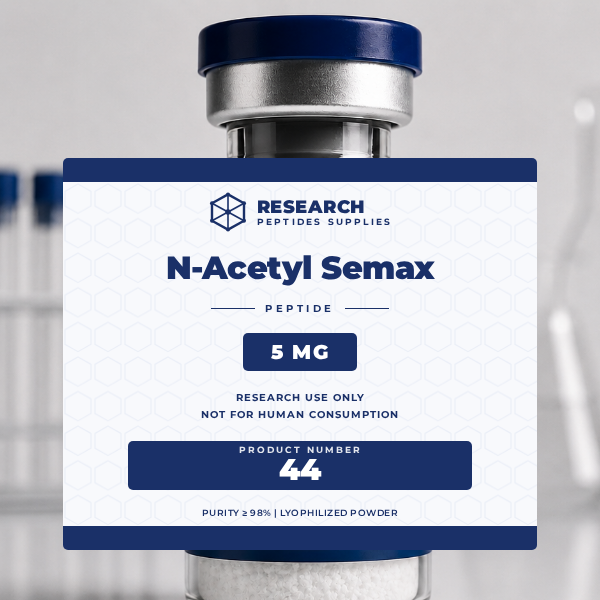
N-Acetyl Semax is a modified form of Semax — the synthetic heptapeptide derived from adrenocorticotropic hormone (ACTH(4-7)-PGP) — in which an acetyl group has been added to the N-terminus. This acetylation modification is designed to improve the peptide’s stability against aminopeptidase degradation, increasing its effective duration in biological research models. N-Acetyl Semax (also written as NA Semax) shares Semax’s core ACTH(4-7) sequence (Met-Glu-His-Phe) and the Pro-Gly-Pro (PGP) C-terminal extension, retaining the same receptor interactions but with enhanced pharmacokinetic properties.
N-Acetyl Semax is a modified form of Semax — the synthetic heptapeptide derived from adrenocorticotropic hormone (ACTH(4-7)-PGP) — in which an acetyl group has been added to the N-terminus. This acetylation modification is designed to improve the peptide’s stability against aminopeptidase degradation, increasing its effective duration in biological research models. N-Acetyl Semax (also written as NA Semax) shares Semax’s core ACTH(4-7) sequence (Met-Glu-His-Phe) and the Pro-Gly-Pro (PGP) C-terminal extension, retaining the same receptor interactions but with enhanced pharmacokinetic properties. The research rationale for N-Acetyl Semax versus native Semax lies in duration of effect. Semax’s biological activity in brain tissue is limited by rapid peptide degradation by aminopeptidases. Acetylation at the N-terminus blocks this degradation pathway, extending the period during which the peptide can interact with receptors and activate downstream signaling cascades — particularly BDNF upregulation and TrkB receptor activation. Research models suggest N-Acetyl Semax produces more sustained BDNF gene expression upregulation than an equivalent dose of native Semax.
Research Background
The research rationale for N-Acetyl Semax versus native Semax lies in duration of effect. Semax’s biological activity in brain tissue is limited by rapid peptide degradation by aminopeptidases. Acetylation at the N-terminus blocks this degradation pathway, extending the period during which the peptide can interact with receptors and activate downstream signaling cascades — particularly BDNF upregulation and TrkB receptor activation. Research models suggest N-Acetyl Semax produces more sustained BDNF gene expression upregulation than an equivalent dose of native Semax.
Key Research Areas
- Cognitive Research: Working memory, attention, and learning in rodent behavioral models
- BDNF Research: Sustained BDNF gene expression upregulation and TrkB receptor signaling
- Neuroprotection Research: Ischemic damage reduction and oxidative stress neuroprotection studies
- Neuroplasticity Research: Hippocampal neurogenesis and synaptic plasticity models
- Mood Research: Anxiety, depression-related behavior, and serotonin system interactions
- Pharmacokinetics Research: Acetylated vs. native peptide stability and CNS penetration comparison
Technical Specifications
| Parameter | Value |
|---|---|
| Classification | N-Acetylated Semax analog (acetylated ACTH(4-7)-PGP derivative) |
| Molecular Weight | ~890 Da |
| Purity | ≥98% (HPLC-verified) |
| Form | Lyophilized powder, sealed under argon |
| Storage | −20°C (long-term) |
| Documentation | Batch-specific COA (HPLC + Mass Spec) |
Storage & Handling (Research Laboratories)
Lyophilized N-Acetyl Semax should be stored at −20°C for long-term preservation, protected from light and moisture. For short-term active research use, 4°C storage is acceptable for up to approximately 4 weeks. Minimize repeated freeze-thaw cycles. Follow standard laboratory peptide reconstitution and handling protocols for all experimental use.