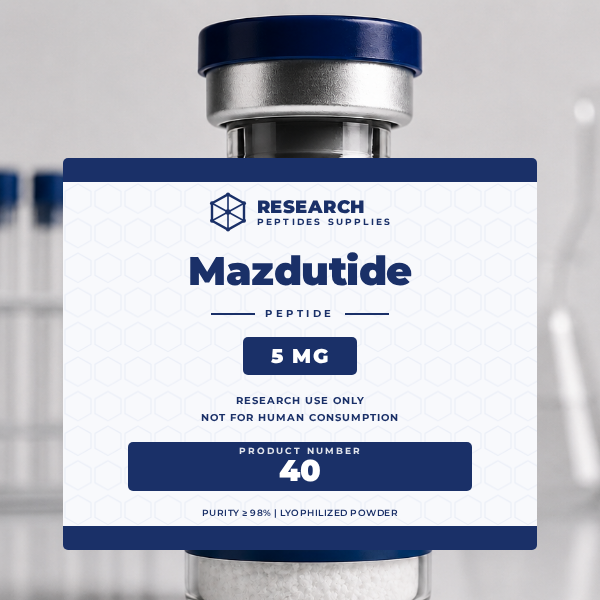
Mazdutide Research Peptide — Scientific Overview
Mazdutide (IBI362) is a dual GLP-1 and glucagon receptor agonist developed by Innovent Biologics (China). It belongs to the same mechanistic class as Survodutide — simultaneously engaging GLP-1R for satiety, insulin secretion, and glucose regulation, and GCGR for hepatic fat mobilization and energy expenditure. Mazdutide is distinguished by its acylated design enabling once-weekly subcutaneous dosing and by its clinical development program largely conducted in Chinese populations.
Mazdutide (IBI362) is a dual GLP-1 and glucagon receptor agonist developed by Innovent Biologics (China). It belongs to the same mechanistic class as Survodutide — simultaneously engaging GLP-1R for satiety, insulin secretion, and glucose regulation, and GCGR for hepatic fat mobilization and energy expenditure. Mazdutide is distinguished by its acylated design enabling once-weekly subcutaneous dosing and by its clinical development program largely conducted in Chinese populations. Phase II data for Mazdutide showed significant body weight reductions (approximately 11% at 24 weeks) and robust glycemic improvements in Type 2 diabetes patients. Phase III trials (GLORY series) are ongoing for obesity and Type 2 diabetes in China, with submission for approval expected. Mazdutide’s clinical data contribute to the body of evidence supporting dual GLP-1/glucagon agonism as a therapeutic approach in metabolic disease, and provide a comparator for researchers studying this class.
Research Background
Phase II data for Mazdutide showed significant body weight reductions (approximately 11% at 24 weeks) and robust glycemic improvements in Type 2 diabetes patients. Phase III trials (GLORY series) are ongoing for obesity and Type 2 diabetes in China, with submission for approval expected. Mazdutide’s clinical data contribute to the body of evidence supporting dual GLP-1/glucagon agonism as a therapeutic approach in metabolic disease, and provide a comparator for researchers studying this class.
Key Research Areas
- GLP-1/Glucagon Dual Agonism Research: GCGR and GLP-1R co-activation studies in metabolic models
- Obesity Research: Weight reduction, adipose biology, and energy metabolism studies
- Type 2 Diabetes Research: Glycemic control, insulin secretion, and β-cell biology
- NAFLD/MASH Research: Hepatic fat content reduction and liver biology studies
- Comparative Pharmacology: Mazdutide vs. other dual/triple agonists — mechanism comparison
- Metabolic Syndrome Research: Multi-faceted cardiometabolic risk factor modulation studies
Technical Specifications
| Parameter | Value |
|---|---|
| Classification | Dual GLP-1/Glucagon receptor agonist (IBI362) |
| Developer | Innovent Biologics |
| Purity | ≥98% (HPLC-verified) |
| Form | Lyophilized powder, sealed under argon |
| Storage | −20°C (long-term) |
| Documentation | Batch-specific COA (HPLC + Mass Spec) |
Storage & Handling (Research Laboratories)
Lyophilized Mazdutide should be stored at −20°C for long-term preservation, protected from light and moisture. For short-term active research use, 4°C storage is acceptable for up to approximately 4 weeks. Minimize repeated freeze-thaw cycles. Follow standard laboratory peptide reconstitution and handling protocols for all experimental use.