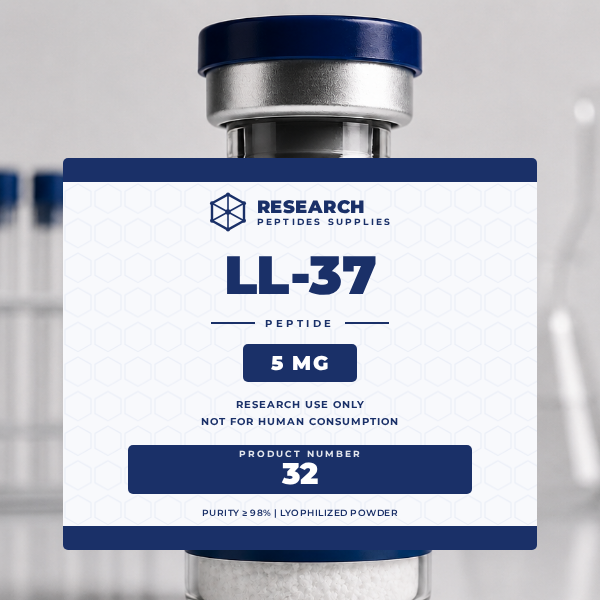
LL-37 Research Peptide — Scientific Overview
LL-37 is the sole cathelicidin produced in humans, encoded by the CAMP gene on chromosome 3. It is derived from the C-terminal domain of the hCAP18 protein (human cationic antimicrobial protein 18) through serine protease cleavage. The mature LL-37 peptide consists of 37 amino acids with a predominantly cationic (positively charged) character that enables direct interaction with and disruption of negatively charged bacterial, viral, and fungal membranes. LL-37 is produced by neutrophils, mast cells, monocytes, macrophages, natural killer cells, epithelial cells, and many other cell types — making it a broadly expressed component of innate immunity.
LL-37 is of exceptional interest in biomedical research because it occupies a unique position at the interface of innate immunity, microbiome regulation, and tissue repair. Unlike most antimicrobial peptides that function solely through membrane disruption, LL-37 also acts as an immunomodulator — it can both pro-inflammatory and anti-inflammatory effects depending on context, and it interacts with multiple host cell receptors including FPRL-1, EGFR, P2X7, and TLR signaling pathways.
Research Background
Published LL-37 research spans antimicrobial research (broad-spectrum activity against bacteria, fungi, viruses), innate immunity and host defense, wound healing biology, cancer biology (complex dual pro- and anti-tumor effects in different cancer types), autoimmune research (roles in psoriasis, lupus), and microbiome modulation. LL-37 is in active clinical development for several indications including chronic wounds and respiratory infections.
Key Research Areas
- Antimicrobial Research: Membrane disruption mechanisms against gram-positive, gram-negative, fungi, and viruses
- Innate Immunity Research: Host defense peptide biology and immune modulation studies
- Wound Healing Research: Epithelial migration, angiogenesis, and wound repair pathway studies
- Cancer Biology Research: LL-37 dual pro/anti-tumor effects in different cancer cell line studies
- Autoimmunity Research: LL-37 roles in psoriasis pathology and lupus biology
- Microbiome Research: Host-microbiome interaction and antimicrobial peptide ecology studies
Technical Specifications
| Parameter |
Value |
| Sequence |
LLGDFFRKSKEKIGKEFKRIVQRIKDFLRNLVPRTES |
| Molecular Weight |
4493.3 Da |
| Purity |
≥98% (HPLC-verified) |
| Form |
Lyophilized powder, sealed under argon |
| Storage |
−20°C (long-term); 4°C (short-term) |
| Documentation |
Batch-specific COA (HPLC + Mass Spec) |
Storage & Handling (Research Laboratories)
Lyophilized LL-37 should be stored at −20°C for long-term preservation, protected from light and moisture. For short-term active research use, 4°C storage is acceptable for up to approximately 4 weeks. Minimize repeated freeze-thaw cycles. Follow standard laboratory peptide reconstitution and handling protocols for all experimental use.
Frequently Asked Questions — LL-37 Research
How does LL-37 kill bacteria mechanistically?
LL-37 kills bacteria primarily through direct membrane disruption — a mechanism involving several steps: (1) Electrostatic attraction of the cationic LL-37 to the negatively charged bacterial cell surface (LPS in gram-negatives, lipoteichoic acid in gram-positives); (2) Insertion of LL-37’s amphipathic α-helix into the hydrophobic core of the bacterial membrane; (3) Formation of pores or membrane disintegration (the exact mechanism — toroidal pore, barrel-stave, or carpet model — may vary by bacterial species and local peptide concentration). LL-37 also disrupts membrane integrity through carpet-like covering and detergent-like mechanisms. Because it targets the fundamental physics of the bacterial membrane rather than a specific protein, bacterial resistance mechanisms are difficult to develop against LL-37.
What immunomodulatory properties does LL-37 have beyond direct antimicrobial effects?
LL-37’s immunomodulatory profile is complex and context-dependent. It acts as a chemokine — attracting neutrophils, monocytes, macrophages, and mast cells to infection sites. It activates epithelial cells through EGFR signaling to promote proliferation and migration. It modulates TLR signaling — can suppress LPS-induced TLR4 inflammatory responses in some contexts while amplifying TLR9 responses in others. It forms complexes with self-DNA and RNA that activate TLR9/7 in plasmacytoid dendritic cells — a property implicated in the pathology of psoriasis and lupus where LL-37 drives IFN-α production and autoimmune activation.
What is the role of LL-37 in wound healing?
LL-37 plays multiple roles in wound repair: (1) Direct antimicrobial protection of the wound against infection; (2) Promotion of keratinocyte and fibroblast migration through EGFR and PI3K signaling activation; (3) Stimulation of angiogenesis through VEGF induction and endothelial cell activation; (4) Modulation of inflammatory cells at the wound site. Published research has documented that LL-37-deficient mice show impaired wound healing, while topical LL-37 application in wound models accelerates closure rates. LL-37 is in clinical development for chronic wound treatment (ventrix.com trials).
Is LL-37 in any clinical trials?
Yes. LL-37 has been investigated in multiple clinical trials. Promore Pharma (Sweden) has conducted Phase II trials examining a modified LL-37 analog (LL37) for venous leg ulcers and hard-to-heal wounds. Results of a 2021 Phase II trial reported on ClinicalTrials.gov showed statistically significant improvement in wound healing compared to placebo in a subgroup analysis. LL-37 remains investigational and is not approved for human therapeutic use. Research Peptides Supplies supplies LL-37 for qualified laboratory research use only.
What documentation comes with LL-37?
LL-37 from Research Peptides Supplies is verified at ≥98% purity by HPLC with identity confirmed by Mass Spectrometry. A batch-specific COA is provided with every order.
⚗️ Research Use Only: This product is strictly intended for qualified laboratory and scientific research use by trained professionals in appropriate laboratory settings. It is not intended for human or veterinary administration, therapeutic use, food supplement applications, or any use outside controlled research environments. Not for human consumption.