⌕♙🛒

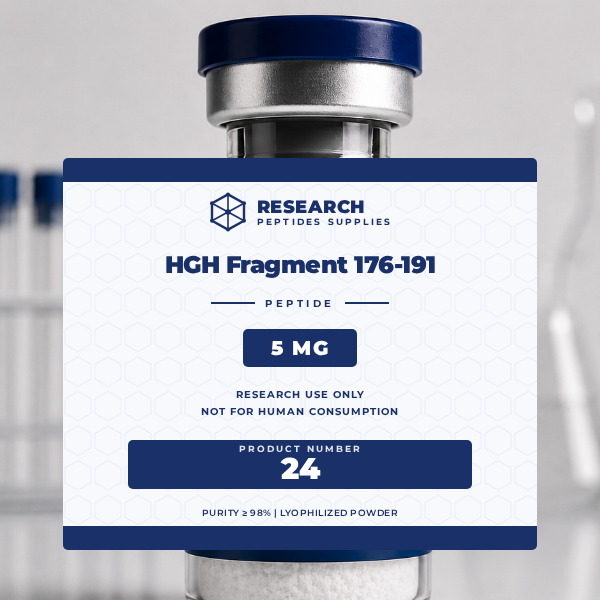
HGH Fragment 176-191

$37.99

HGH Fragment 176-191 — the C-terminal fragment of human growth hormone (amino acids 176-191) that encompasses the lipid-mobilizing domain of hGH. Studied for adipocyte lipolysis research, metabolic biology, and as a selective GH domain research tool without growth-promoting effects. Supplied lyophilized at ≥98% purity (HPLC-verified) with batch-specific COA. For research use only.

SKU: RPS-HGH176-001 Category: Tags: ,

HGH Fragment 176-191 Research Peptide — Scientific Overview

HGH Fragment 176-191 is a synthetic 16-amino-acid peptide corresponding to amino acid positions 176-191 of the human growth hormone sequence. This C-terminal fragment isolates the portion of hGH that has been associated with the hormone’s lipolytic (fat-mobilizing) activity in research models. The fragment contains a disulfide bond between Cys182 and Cys189 that is present in the native hGH structure and contributes to the peptide’s three-dimensional conformation and bioactivity.

The rationale for studying isolated GH domain fragments like hGH(176-191) stems from research demonstrating that growth hormone’s diverse biological effects are mediated by different structural domains. The N-terminal region of GH mediates growth-promoting, diabetogenic, and IGF-1-inducing effects through classical GH receptor activation. The C-terminal 176-191 region, in contrast, appears to stimulate lipolysis through mechanisms that do not require classical GH receptor activation, making it possible to study fat-mobilizing biology without growth promotion or insulin resistance confounds.

Research Background

Research with hGH(176-191) in rodent models has documented stimulation of lipolysis in isolated adipocytes, inhibition of lipogenesis in fat tissue, and reductions in body fat mass without the growth-promoting effects of full hGH. The fragment has been proposed to act through β-adrenergic receptor mechanisms in adipose tissue. Its study has contributed to understanding the structure-activity relationships within the GH molecule and the potential for fragment-based approaches to metabolic research.

Key Research Areas

  • Lipolysis Research: Adipocyte fat mobilization and anti-lipogenic studies in cell and animal models
  • GH Domain Research: Structure-activity relationship studies of C-terminal hGH fragment bioactivity
  • Adipose Biology Research: Fat tissue biology and triglyceride metabolism studies
  • Metabolic Research: Body composition and fat mass modulation in animal metabolic models
  • β-Adrenergic Research: β3-adrenergic receptor pathway activation in adipose tissue
  • Comparative Research: GH fragment vs. full hGH lipolytic mechanism comparison

Technical Specifications

Parameter Value
Sequence Leu-Arg-Ile-Val-Gln-Cys-Arg-Ser-Val-Glu-Gly-Ser-Cys-Gly-Phe (aa 176-191 of hGH)
Molecular Weight ~1818 Da (includes disulfide bond)
Purity ≥98% (HPLC-verified)
Form Lyophilized powder, sealed under argon
Storage −20°C (long-term)
Documentation Batch-specific COA (HPLC + Mass Spec)

Storage & Handling (Research Laboratories)

Lyophilized HGH Fragment 176-191 should be stored at −20°C for long-term preservation, protected from light and moisture. For short-term active research use, 4°C storage is acceptable for up to approximately 4 weeks. Minimize repeated freeze-thaw cycles. Follow standard laboratory peptide reconstitution and handling protocols for all experimental use.
Frequently Asked Questions — HGH Fragment 176-191 Research

What is the C-terminal lipolytic domain of hGH?
Through structural studies and research with truncated GH fragments, researchers identified that the C-terminal portion of hGH (approximately residues 176-191) has lipolytic activity that is distinct from the growth-promoting N-terminal region’s mechanism. This domain does not appear to engage the classical GH receptor with high affinity, suggesting it acts through alternative pathways to stimulate adipose tissue fat breakdown. The disulfide bridge between Cys182-Cys189 in this region appears important for maintaining the correct bioactive conformation.
How does HGH 176-191 differ from AOD-9604?
HGH Fragment 176-191 and AOD-9604 are closely related but not identical. Both are based on the C-terminal lipolytic domain of growth hormone. The key difference is that AOD-9604 typically includes an additional N-terminal tyrosine residue added before the 176 position, creating a 17-residue peptide rather than the native 16-residue fragment 176-191. This tyrosine addition was made during AOD-9604’s pharmaceutical development to improve the compound’s pharmacokinetic and stability properties. Some research and commercial sources use the terms interchangeably — researchers should verify the exact sequence through Mass Spectrometry data on the COA.
What animal model evidence exists for HGH 176-191’s lipolytic effects?
In vitro studies using isolated rat and human adipocytes have documented that hGH(176-191) stimulates lipolysis (glycerol and free fatty acid release) in a dose-dependent manner. In vivo rodent studies have shown reductions in fat mass with fragment administration compared to vehicle controls. Comparative studies with full hGH demonstrated that the fragment stimulates lipolysis while lacking hGH’s growth-promoting and insulin-desensitizing effects — validating the domain-selective pharmacology hypothesis. These findings are all from preclinical models.
Is HGH Fragment 176-191 approved for human use?
No. HGH Fragment 176-191 is not approved for human therapeutic use. Research Peptides Supplies supplies it for qualified laboratory research use only.
What documentation comes with HGH Fragment 176-191?
HGH Fragment 176-191 from Research Peptides Supplies is verified at ≥98% purity by HPLC, with identity confirmed by Mass Spectrometry confirming the correct molecular weight and disulfide bond formation. A batch-specific COA is provided with every order.
⚗️ Research Use Only: This product is strictly intended for qualified laboratory and scientific research use by trained professionals in appropriate laboratory settings. It is not intended for human or veterinary administration, therapeutic use, food supplement applications, or any use outside controlled research environments. Not for human consumption.
Shopping Cart
Scroll to Top